Imagine a field where sunlight feeds both crops and circuits — where the same patch of land grows food and power, nurturing livelihoods while lighting homes. This is not a vision of the distant future but the emerging reality of agrivoltaics, the harmonious blend of agriculture and solar energy generation that is reshaping how we think about land, livelihoods, and sustainability.
Agri-voltaic systems or solar farming, is a technology that allows farmers to harvest both electricity and food side by side. By installing solar panels above crops, farmers create a shared space where every ray of sunlight is put to work. The panels generate clean energy while offering gentle shade, keeping the soil cooler and more moist. This not only reduces water needs but also protects plants from extreme heat, helping them grow stronger and healthier.
Originally conceptualized by Adolf Goetzberger and Armin Zastrow in 1981. Across rural India, this dual-use model is helping farmers achieve energy independence and climate resilience, a true win-win for both people and the planet.
In Jharkhand, the potential shines even brighter. A Centre for Environment and Energy Development (CEED) analysis reveals that by using just 1% of its cropland, the state could unlock an agrivoltaic potential of 9.4 GW. That means a small fraction of land could produce immense returns, powering villages, revitalizing rural livelihoods, and building a sustainable and energy-secure Jharkhand.
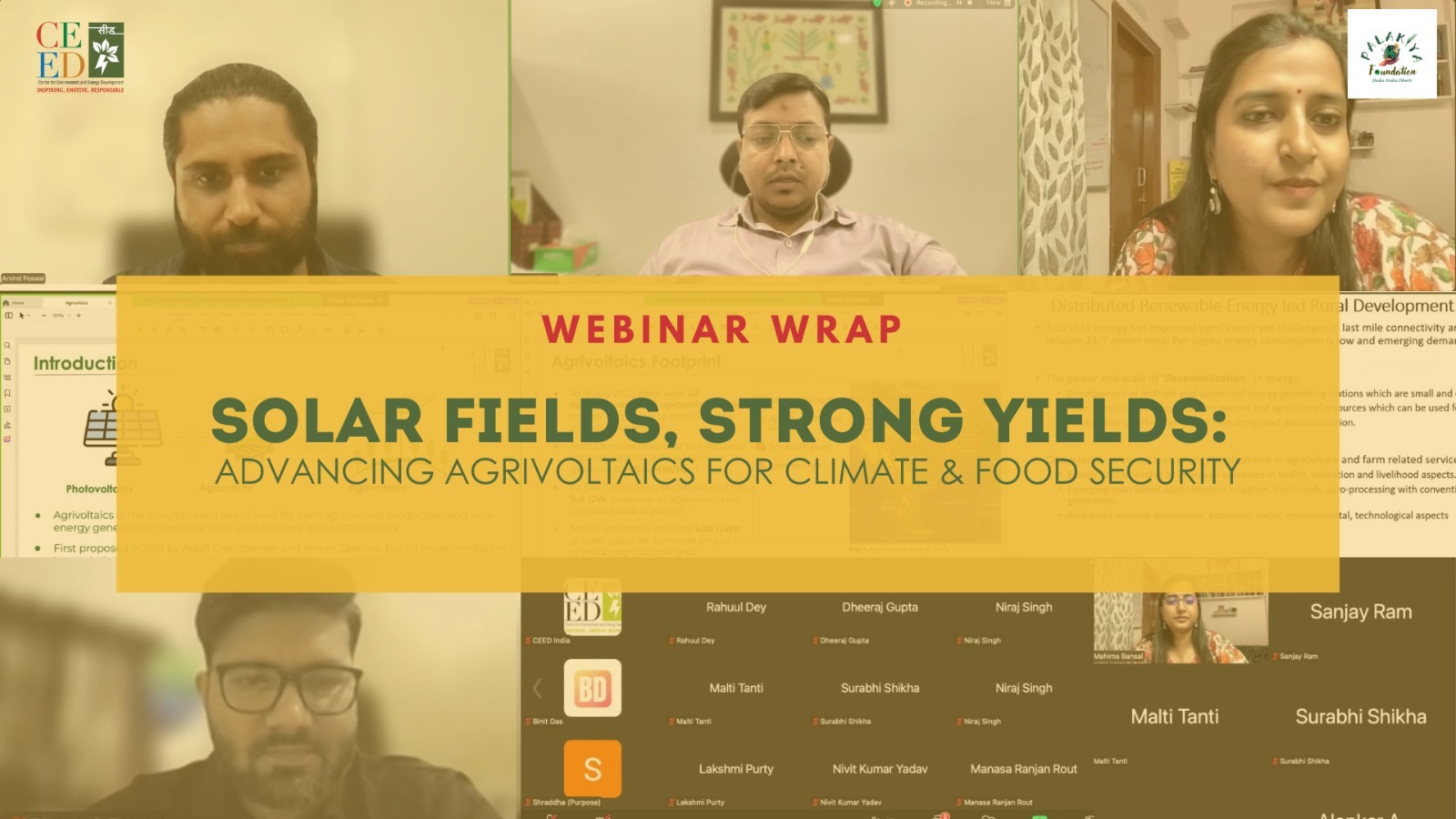
To explore this opportunity further, CEED in collaboration with the Palakiya Foundation, hosted a webinar titled “Solar Fields, Strong Yields: Advancing Agrivoltaics for Climate and Food Security” under the broader theme “Harnessing the Power of Innovation for a Sustainable Future.”
The session brought together experts, practitioners, and changemakers to share insights on how blending solar energy with agriculture can strengthen food security, enhance rural incomes, and build resilience against climate challenges proving that innovation in the fields can power a sustainable tomorrow.
Unlocking India’s Agrivoltaic Promise
Opening the session, Ashwani Ashok from CEED, set the context by highlighting Jharkhand’s agrivoltaic potential of 9.4 GW, assuming just 1% of the state’s cropland is utilized. With its abundant solar resources and agricultural base, Jharkhand represents a powerful testbed for this innovation.
Policy frameworks like the PM-KUSUM Scheme are already laying the groundwork by promoting solarization in agriculture through standalone pumps and solar plants on barren land. The model offers dual revenue streams; farmers earn from solar energy while maintaining agricultural yields, with a capital payback period of just 4–7 years.
Looking ahead, Ashok noted the government’s draft National Agrivoltaics Mission, which envisions bringing 10–15% of India’s agricultural land under agrivoltaic systems by 2035, signaling a strong policy intent toward integration of clean energy and agricultural productivity.
Lessons from the World: Dual-Use Land Done Right
Dheeraj Kumar Gupta from WRI India brought a global lens to the conversation, pointing to international examples that demonstrate agrivoltaics’ efficiency and scalability. Agrivoltaics promotes dual land use, allowing farmers to grow crops and generate solar energy simultaneously. Studies indicate 150 –160% land-use efficiency, showing how effectively this model maximizes productivity. Countries like Germany, Japan, and the EU are already leading the way. Japan alone operates over 3,000 small-scale agrivoltaic systems, setting a global example for sustainable farming innovation.
However, Gupta emphasized that technical design challenges remain. Factors like panel height, tilt angle, and shading optimization significantly affect both crop growth and cost viability. Elevated structures, though beneficial for crop space, can increase costs up to 2.5 times compared to traditional solar installations. Limited field data and lack of farmer awareness, he noted, continue to slow widespread adoption.
Designing Smart, Inclusive Systems
Mahima Bansal from Palakiya Foundation highlighted how agrivoltaics offers a sustainable dual-use solution for India’s growing food and energy demand. By integrating solar systems with crop planning, understanding the light response curves and photosynthetic needs of crops, farmers can ensure that productivity remains unaffected. She further added that studies show no significant decline in yields post-installation, particularly for crops suited to partial shading. The result is a more resilient agricultural system that supports energy self-reliance and economic stability for smallholders.
Ground Realities: Voices from the Field
Bringing a grassroots perspective, Sanjay Ram, a farmer and agricultural trainer, shared the lived experience of agrivoltaic adoption. He noted how agrivoltaics brings the best of both worlds: irrigation support and renewable energy generation. But for large-scale success, there’s a need for capacity building and training programs. Many rural areas still lack skilled solar technicians, which can slow down adoption. Strengthening government-NGO partnerships and investing in community-based training will be essential to ensure long-term success and farmer empowerment.
Similarly, Niraj Singh from PRADAN pointed to water scarcity and inter-departmental coordination as key determinants of project success. He emphasized understanding farmers’ perspectives, many of whom are already shifting to solar due to its cost advantages over diesel. Successful implementation will require interdepartmental coordination and inclusive planning that puts farmers’ needs first.
The Way Forward: From Pilot to Policy
Rounding off the discussion, Arvind Poswal from the Centre for Science and Environment (CSE) placed agrivoltaics within the broader narrative of rural resilience and equitable development. Beyond energy and crop yields, agrivoltaics strengthens community resilience, enhances rural energy access, and supports human capital development by providing stable income alternatives. Ideal crops include leafy vegetables, turmeric, aloe vera, cereals, pulses, and fruits.
However, Poswal cautioned that progress depends on policy clarity, financial innovation, and better integration of existing schemes such as PM-KUSUM, the Mission for Integrated Development of Horticulture (MIDH), and the Agriculture Infrastructure Fund. A mix of farmer-owned, community, and developer-led business models will be key to scaling up agrivoltaics sustainably.
Conclusion: Powering Fields, Empowering Futures
India is steadily embracing this green revolution. As the session concluded, one truth stood clear that agrivoltaics is not merely a technological experiment; it’s a vision of harmony between growth and sustainability. By allowing the sun to nourish both crops and communities, it redefines what rural development can look like in a climate-resilient India.
For farmers, developers, and policymakers alike, the next few years will be pivotal. With strong partnerships, supportive policies, and innovative financing, agrivoltaics can move from the margins to the mainstream, powering not just fields, but futures, where every acre tells a story of light, livelihood, and lasting change.