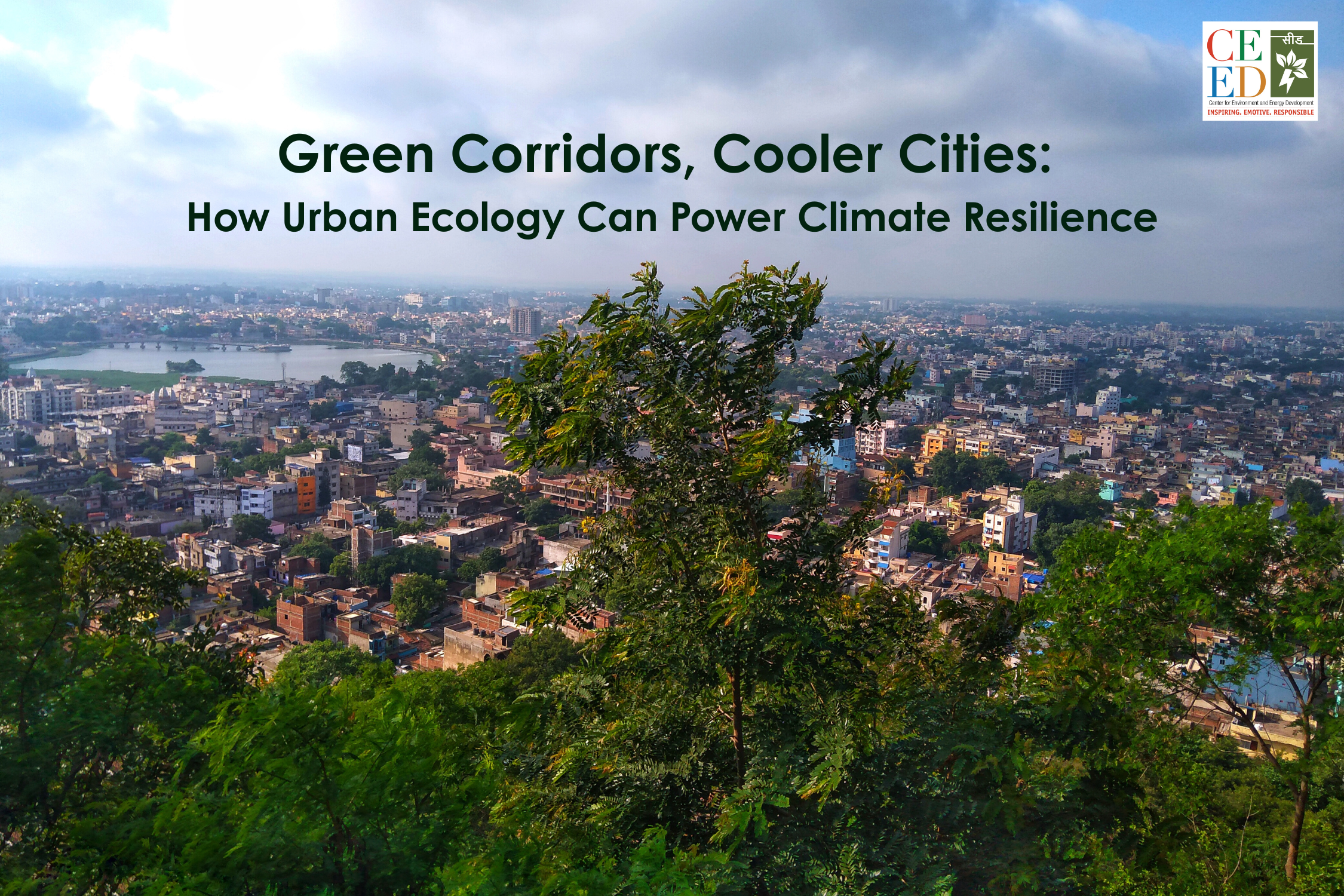
Climate change is reshaping urban landscapes across the world, fueling extreme heat, intensifying erratic weather, and straining essential resources. In India, the pace of urbanization has only magnified these challenges. Ranchi, the capital of Jharkhand, stands at a critical crossroads. Its unique terrain, rising population, and expanding built-up areas are making the city increasingly vulnerable to heatwaves, water stress, flooding, and declining environmental health.
Responding to these urgent risks, Center for Environment and Energy Development (CEED) has developed the Ranchi City Climate Action Plan (R-CAP), a forward-looking, evidence-driven roadmap designed to enhance climate resilience while promoting sustainable and inclusive urban growth. Central to this vision is the revival of urban ecology through green corridors, biodiversity linkages, and climate-sensitive landscape planning. Restoring nature within city boundaries is no longer optional. It is a foundational strategy for reducing Urban Heat Island effects, improving air quality, and building long-term climate resilience.
Over the past two decades, Ranchi has witnessed a loss of more than 25% of its green cover, even as built-up areas continue to expand. This imbalance has fueled rising temperatures, degraded environmental quality, and impacted public health. Yet, the remedy lies within the city’s own ecological fabric. Strengthening green corridors, reconnecting fragmented natural habitats, and adopting climate-smart landscaping practices offer a powerful, nature-based pathway to protect Ranchi’s environment and safeguard its future.
The R-CAP outlines a Strategic Pathway for Phased Climate Action (2025–2037) and is closely aligned with the Ranchi Master Plan 2037, ensuring a unified approach to climate-smart urban development. It addresses key challenges such as water scarcity, flooding and waterlogging, heatwaves and Urban Heat Islands (UHIs), poor waste management, and air pollution. The current focus centers on exploring how urban ecology can drive and strengthen climate resilience across the city.The report a section presents the Urban Greening and Urban Heat Management is divided into 3 phases. Each phase includes clear targets, measurable indicators, and sector-specific interventions. As the city heats up, expands, and faces growing environmental stress, green corridors and urban ecology become more than aesthetic features; they become essential infrastructure.
The Urban Greening and Urban Heat Management strategy is built around two powerful pillars: open and green urban spaces, which restore nature across the city, and cooling & greening strategies in buildings and urban design, which embed climate-smart, heat-reducing solutions into the built environment. Together, they cool, refresh, and future-proof Ranchi.
a. Phased Plan for Enhancing Urban Green Cover:
Phase 1 (2025–28) focuses on establishing a strong green foundation for Ranchi. Key actions include maintaining the extensive 1043-hectare green belt along the Ring Road and initiating new plantation drives along major stretches such as Ranchi–Purulia Road (Namkum) and Booty More–Khelgaon Road. Green belts will also be created in wards with high Urban Heat Island (UHI) intensity. The phase also prioritizes developing a city park with a dense green canopy, creating a 0.8-hectare neighbourhood park in Namkum, and launching a Green Stewardship Programme to engage students in planting saplings. Public awareness will be strengthened through regular campaigns highlighting the importance of preserving green cover.
Phase 2 (2028–32) expands greening efforts across more corridors of the city. Plantation drives will be extended to major roads such as MG Road, Old HB Road, and Purulia Road, accompanied by measures to address encroachment and disorganized parking. This phase also includes identifying strategic locations within the city to introduce new green belts, corridors, and urban parks, ensuring equitable distribution of green spaces.
Phase 3 (2032–37) emphasizes long-term sustainability through consistent maintenance. Activities include regular upkeep of roadside green belts, tree lines, and all existing parks. Additionally, artificial water bodies will be developed to moderate temperatures, enhance microclimates, and support cooler urban surroundings.
The phase-wise strategy lays out a comprehensive framework that guides the city from foundational greening efforts to large-scale ecological enhancement and long-term maintenance. By detailing specific interventions such as developing green belts, revitalizing parks, creating shaded public areas, and restoring ecological corridors, the plan ensures that every phase contributes to a cooler, greener, and more climate-resilient urban environment. This structured approach not only prioritizes environmental restoration but also ensures equitable access to quality green spaces for all residents.
b. Phased Plan for Cooling & Greening Strategies in Buildings & Urban Design
Phase 1 (2025-28) focuses on citywide cooling measures, including implementing cool or green roofs in 60–70% of government buildings and piloting green facades to showcase their benefits. The M.G. Road sidewalk (2.2 km) will serve as a demonstration corridor for upgrading pavements to cooler or softscaped designs. Design guidelines for cool roofs, facades, and reflective pavements will be developed for future use. The phase also promotes vertical and rooftop gardening and the creation of shaded roadside areas, especially near traffic lights to improve comfort during extreme heat.
Phase 2 (2028-32) – This phase aims to achieve 100% cool or green roof coverage across all remaining government buildings and extend adoption to 20–30% of residential and commercial structures through incentives and awareness. Green facades will be installed on suitable public buildings, while key roads – Purulia Road, Kadru Main Road, and Old HB Road will be upgraded with cool pavers. All new sidewalks and parking areas will use reflective, cool pavements with softscaping. Incentive schemes such as tax rebates will further encourage private adoption of cool and green roofing solutions.
Phase 3 (2032-37) – Regular maintenance of green roofs, cool roofs, and green facades across all public and private buildings to ensure long-term functionality and aesthetic quality. Expansion of cool/ green roofing coverage in:
a.) an additional 30-40% of residential and commercial buildings.
b.) all new constructions, as a standard building design feature.
Ensuring all new sidewalks, footpaths, and open parking areas are developed with reflective, permeable, and cool pavements integrated with vegetation or soft scaping. Periodic evaluation of thermal comfort benefits and reduction in local surface temperature using satellite and in-situ temperature monitoring.
It provides a structured and actionable framework for integrating cooling and greening strategies into Ranchi’s buildings and overall urban design. It details a phased approach that begins with pilot projects and foundational guidelines, gradually expanding to widespread adoption across public, residential, and commercial spaces. By focusing on cool roofs, green facades, reflective pavements, shaded walkways, and climate-responsive design standards, the plan ensures that built environments actively contribute to reducing urban heat. This roadmap not only enhances thermal comfort and energy efficiency but also embeds climate resilience into the city’s future development fabric.
Ranchi stands at a defining moment, one where urban development and ecological integrity can advance together. The Ranchi Climate Action Plan charts a hopeful, future-ready path that restores the city’s natural systems while supporting sustainable growth. By strengthening green corridors, enhancing open spaces, and integrating climate-smart design into buildings and streetscapes, Ranchi is choosing a resilient, cooler, and healthier urban future. These interventions are not merely environmental measures; they are long-term investments in well-being, equity, and economic vitality. With commitment, collaboration, and community stewardship, Ranchi can emerge as a model city where nature and development thrive in harmony.
For more details, you can download the full report using the link provided – https://ceedindia.org/download/ranchi-climate-action-plan-2025/