For millions of rural households in India, cooking remains one of the most persistent and overlooked development challenges. Despite major strides in electrification and energy access, over 660 million people continue to rely on solid fuels such as firewood, crop residue, and dung fo r everyday cooking (NFHS-5, 2019–21). In rural India, nearly 60% of households still use traditional biomass-based chulhas.
Jharkhand reflects this reality even more starkly. Over 70% of rural households depend on solid fuels for cooking, exposing women and children to sustained household air pollution. In several districts of the state, where poverty, forest dependence, and limited access to alternatives intersect, cooking energy remains deeply tied to survival rather than choice.
Beyond the Problem: What Clean Cooking Solutions Exist Today?
Clean cooking is often discussed as a single solution, most commonly LPG. In reality, it is a spectrum of options, each with strengths and constraints:
- LPG (Ujjwala Yojana): Clean at point of use, fast, and familiar
- Improved Cookstoves (ICS): Lower smoke, higher efficiency, reduced fuel use
- Electric cooking: Cleanest option, but dependent on reliable power and affordability
- Biogas: Sustainable and local, but limited by water, cattle availability, and upkeep
The challenge is not the absence of solutions, but the mismatch between technology design, affordability, and everyday rural realities.
What Ujjwala Achieved, and Where It Falls Short
The Pradhan Mantri Ujjwala Yojana (PMUY) has significantly expanded LPG access. As of 2024, over 95 million LPG connections have been released nationally, with near-universal coverage in many states.
However, access has not translated into sustained use.
Ground studies across eastern and central India show:
- Many rural households use 1–3 LPG cylinders per year, far below full adoption levels
- LPG is often used as a secondary fuel, alongside firewood
- High refill costs, income volatility, and cultural cooking preferences limit regular use
In Jharkhand, LPG connections exist in many villages, but biomass remains the default for daily cooking.
This gap highlights a key lesson: clean cooking transitions cannot be solved by connections alone.
Where Improved Cookstoves Fit In
Improved cookstoves are not a replacement for LPG or electric cooking. They are a transitional solution, designed to reduce harm where full clean fuel adoption remains constrained.
Well-designed ICS:
- Improve combustion efficiency
- Reduce smoke and PM2.5 exposure
- Lower firewood consumption by 30–50%
- Retain compatibility with traditional cooking practices
Past ICS programmes across India have seen mixed results. Where designs ignored user behaviour, maintenance, or fuel realities, adoption dropped. Where communities were involved early and technologies matched local needs, uptake was stronger.
What We Learned from Khunti
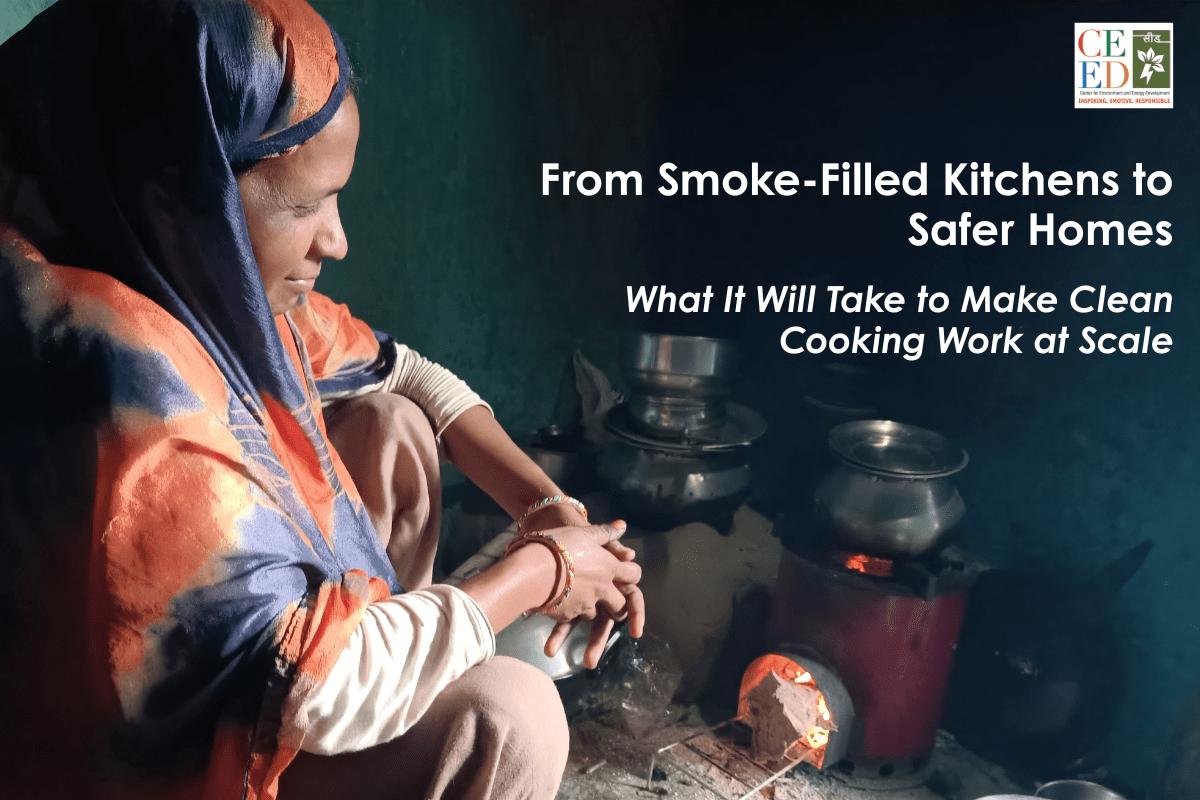
Against this backdrop, CEED piloted improved cookstoves in select villages of Khunti district. including Belangi, Karaa, Dari, Ghunsuli, and Hutar.
The objective was not to “solve” clean cooking, but to test whether low-smoke, fuel-efficient designs aligned with local practices could reduce exposure and ease daily burdens.
Key learnings included:
- Community engagement matters more than distribution
- Women prioritised portability, smoke reduction, and fuel savings
- Reduced firewood use translated into fewer forest trips and less physical strain
- Trust built through demonstrations and trials shaped adoption decisions
“Earlier, the smoke would make children cough constantly. Now the smoke is much less.”
— Bhutan, Belangi village
“This stove uses less firewood and produces very little smoke. Cooking has become easier than before.”
— Rinki Devi, Ghunsuli village, Khunti
These outcomes reinforced that technology works when social design is right.
What Still Doesn’t Work
The pilot also surfaced persistent barriers:
- Upfront affordability remains a constraint due to high cost of fuel
- Access to repair and maintenance is limited
- ICS adoption alone does not eliminate exposure completely
- Ease of availability of other sources at relatively cheaper price, or free of cost due to availability of biomass
Clean cooking cannot rely on single-solution thinking or short-term projects.
Designing a Scalable, Eco-Friendly Transition
The path forward lies in layered solutions, not binaries.
Effective clean cooking strategies must:
- Treat LPG, ICS, and electric cooking as complementary, not competing
- Integrate clean cooking into health, nutrition, and livelihoods programmes
- Support women-led adoption and local entrepreneurship
- Invest in maintenance, training, and last-mile supply ecosystems
- Align climate, forest, and public health objectives at the state level
For states like Jharkhand, clean cooking is as much about resilience and dignity as it is about energy.
Why This Matters for Jharkhand’s Development Path
Jharkhand’s development discourse often centres on electricity, mining, and industry. Cooking energy, despite its direct links to public health, forest conservation, and women’s time poverty, remains under-prioritised.
Promoting clean cooking solutions directly supports:
-
SDG 3 (Good Health and Well-being)
-
SDG 5 (Gender Equality)
-
SDG 7 (Clean Energy Access)
-
SDG 13 (Climate Action)
It also aligns with the state’s goals around decentralised renewable energy, livelihood diversification, and climate resilience.
The Way Forward
The experience from Khunti adds to a growing body of evidence: clean cooking transitions succeed when they are contextual, incremental, and people-led.
The question is no longer whether clean cooking solutions exist, but whether we are willing to design systems that make them usable, affordable, and lasting for those who need them most.
For millions still cooking in smoke-filled kitchens, clean cooking is not aspirational.
It is urgent.
A key consequential outcome amongst these reflecting the shift on action was agreement of Parties to develop a Just Transition Mechanism. The initiative aims to remedy the inconsistent and fragmented approach to just transition through enhanced international cooperation, technical assistance, capacity-building, and knowledge-sharing, and enabling equitable, inclusive just transitions. The mechanism is envisaged as a complementary institutional arrangement that builds upon existing workstreams under the UNFCCC and the Paris Agreement, including the ongoing Just Transition Work Programme. This decision has also reaffirmed that just transitions are complex, multi-dimensional and multi sectoral processes which requires a holistic institutionalized approach considering ground realities and challenges.
Developing economies have limited fiscal space and institutional capacity coupled with high socio-economic vulnerabilities requiring concrete support for planning just transition pathways. The decision to develop just transition mechanisms opens a forward-looking institutional pathway for these regions to adapt just transition roadmaps that are local, inclusive and action oriented. While the mechanism does not yet carry dedicated financial commitments, its institutional anchoring creates space for developing countries to seek coordinated technical support for worker reskilling, community transition planning, and just transition financing frameworks. Importantly, by locating operationalization within the UNFCCC architecture, the mechanism also strengthens the role of national and subnational governments in shaping transition pathways that align climate ambition with development priorities, fiscal capacity, and employment realities.
Subnational Scale Defines Transition & Climate Outcomes
COP30 also placed a strong emphasis on just transition pathways being tailored to national and regional circumstances acknowledging that it unpacks differently across sectors, regions and communities. With the context of the “no one size fits all” approach established globally, the role of subnational governments becomes increasingly central. There also has been growing consensus at the COP30 on climate adaptation and resilience being an integral component of just transition and contributing to protecting communities at the frontline of climate impacts. These factors place the subnational governance as a major catalyst on achieving a just and sustainable transition and broader climate action.
While national commitments shape the global directions, the true battleground of transition is far more local. These are the places where coal-dependent workers will need new livelihoods, where climate shocks are already reconfiguring local economies, and where communities must navigate profound changes in energy, industry, and natural resource systems. Yet these actors often operate with limited fiscal autonomy, constrained technical capacity, and weak access to international climate finance. As multilateral processes like the Just Transition Mechanism take shape, their credibility will rest not only on national commitments but on whether they
meaningfully empower subnational governments to plan, finance, and govern locally grounded transitions in fossil-fuel-dependent, climate-vulnerable, and economically fragile regions.
This subnational imperative is most sharply evident in mineral-rich, fossil fuel-dependent states, such as Jharkhand. The state sits at the intersection of national energy security, local livelihood dependence on fossil fuel industries, and acute climate vulnerability. As India navigates its energy transition, decisions on coal production, mine closures, land restoration, and alternative economic pathways are being played out largely at the state and district levels. In Jharkhand alone, over US$12.5 billion will be required to reskill workers, compensate affected households, and support alternative livelihoods and communities dependent on the fossil fuel economy. Without targeted subnational planning, just transition risks becoming a national narrative without local delivery.
Pathways for Locally Driven Just Transitions
- Institutionalising Just Transition
For just transition to move beyond policy intent and project-based action, institutionalisation is critical. Dedicated governance mechanisms are required to anchor transition objectives within state planning, budgeting, and inter-departmental coordination. Without such embedding, transition efforts remain fragmented across various departments with limited coherence or fiscal convergence. Institutionalising just transition creates continuity beyond political cycles, enables convergence across sectors, and provides a stable interface for engaging national ministries, multilateral institutions, and climate finance providers.
Institutionalising just transition creates continuity beyond political cycles performing three core administrative functions:
- Anchoring transition within the state planning and budget cycle
- Enabling inter-departmental fiscal convergence
- Creating a stable interface for engagement with national ministries, MDBs, and climate finance providers
Across the Global South, efforts to institutionalize transition are beginning to move from isolated projects toward more structured governance arrangements. Several countries and subnational governments are experimenting with dedicated transition cells, inter-ministerial committees, climate finance units, and integrated planning frameworks to embed transition objectives within mainstream development processes.
Leveraging Climate Finance
Amidst negotiations on fossil fuel phase out, just transition, adaptation and resilience, developing countries at COP30 clearly outlined the lack of adequate climate finance and reiterated the onus on developed nations to fill the huge finance gap. As an outcome of this, decisions were taken on scaling and tripling adaptation finance by 2035 and forests-linked finance, alongside greater emphasis on blended finance, multilateral development bank reform, philanthropic capital, and private investment mobilized through de-risking instruments. Together, these shifts expand the range of potential funding sources for place-based transition and resilience investments.
For fossil-fuel-dependent regions, these developments broaden the spectrum of finance that can be tapped for place-based transitions, including:
- Land and mine restorations tied to livelihood creation
- Climate-resilient agriculture and forests-based economies
- Decentralised renewable energy ecosystems
- Diversification of MSMEs and green industrial clusters
- Worker reskilling and social protection
At the same time, COP30 outcomes underscore a key reality; global finance will not automatically flow to subnational levels without strong intermediary systems, state-led planning, and credible project pipelines. Public investment must shift from short-term compensation toward long-term productive rebuilding, including industrial infrastructure and clean manufacturing ecosystems. Additionally, state financial institutions and public procurement systems must be actively used as transition instruments to crowd in private investment and stabilize early transition markets.
The new Just Transition Mechanism emphasizes multilevel governance, providing political space for states to seek technical assistance, pilot funding, and partnerships. However, access will depend on whether subnational governments can articulate clear transition pathways, demonstrate institutional readiness, and anchor community-led design.
2. Enabling State-Level Delivery
Operationalizing just transition at the state level is fundamentally a finance and governance challenge. Translation from principle to delivery depends on whether transition objectives are embedded within the core economic, fiscal, and regulatory machinery of the state along with participatory planning. Global experience shows that transitions succeed only when delivery systems are place-based, labor-centered, and finance-linked.
States require region-specific economic diversification strategies that go beyond reskilling to create actual demand for labor through new industrial clusters, services, and manufacturing ecosystems in post-fossil regions. Additionally, just transition is essentially a people centered project at its core. This requires co-creating and institutionalizing participatory transition planning, allowing workers, women’s groups, Indigenous communities, MSMEs, and youth to shape priorities. When communities are considered as an active player rather than a passive participant of any social scheme, development progresses faster with greater equity and legitimacy.
Looking ahead: Priorities for 2026
Over the coming years, every country is bound to bear the impacts of the inevitable transition. A mechanism which puts people first in the context of the transition is an imperative tool for ensuring that the impending years of change are anchored in equity, justice and inclusivity. COP30 has initiated the creation of an institutional space for just transition but the steps ahead would assure delivery. Operationalization of the global Just Transition Mechanism will depend on clear governance design and finance access modalities. Finance windows are widening, particularly for adaptation, forests, blended finance, and MDB-led de-risking, but subnational access will depend fundamentally on institutional readiness. Subnational capacity, rather than global ambition, is now the binding constraint for transition implementation.
In the Indian context, Jharkhand represents a high-stakes test case where coal dependence, climate vulnerability, and livelihood exposure converge. Institutionalizing transition through the Task Force and related frameworks was a necessary first step. Without hard alignment of DMF flows, green budgeting, and district-level transition planning, just transition might remain an institutional narrative rather than an economic restructuring process. Along with this, formal strengthening of cooperation and structured dialogue between national and local authorities would yield on the ground results.
With the global promise of keeping the momentum up and running in the lead up to COP31 at Antalya, Türkiye in 2026, close eye on domestic implementation of just transition and climate goals would remain crucial. The journey from Belém to the smallest district, ward, or village is a reminder that climate change is global, but solutions must be local. If empowered with the right tools, financing, and partnerships, local governments can turn the promise of just transitions into a lived reality.