Saurav Acharya |
India has long stood at the crossroads of development and sustainability. With our economy booming and population growing, the demand for power surges every year. The question is clear: Can India fuel this growth sustainably and lead the world on clean energy? India is racing against time to power its economic growth without deepening its fossil fuel dependency. Despite crossing its 2030 renewable capacity target five years early, the country still faces a critical gap wherein the optimum clean electricity generation is far behind capacity.
Setting the stage – India’s Climate Commitments
At COP26, India took center stage in voicing the priorities of developing nations: — balancing climate ambition with economic realities. It also unveiled its five-point climate pledge, the Panchamrit, setting a bold course for clean energy leadership:
- 500 GW of renewable installed capacity by 2030.
- 50% of energy requirements from renewables by 2030.
- One billion tonne reduction in carbon emissions by 2030.
- 45% decrease in carbon intensity over 2005 levels by 2030.
- Net zero emissions by 2070 [1,2].
These targets outline more than just numbers, they represent a long-term vision for energy independence, sustainability, and economic resilience. The capacity milestones are impressive, but the harder challenge lies ahead – generating enough clean power to meet the surging demand.
Progress So Far – Milestones & Gaps
India’s renewable momentum has been impressive. As of mid-2025, over 50% of the country’s installed power capacity now comes from renewables, a feat achieved five years early[2]. However, while installed capacity is impressive, actual generation from renewables and nuclear still lags at only about 31.9% of total electricity produced as of June 2025 [3], as shown in Fig. 1. This gap between capacity and generation is where the real story lies.
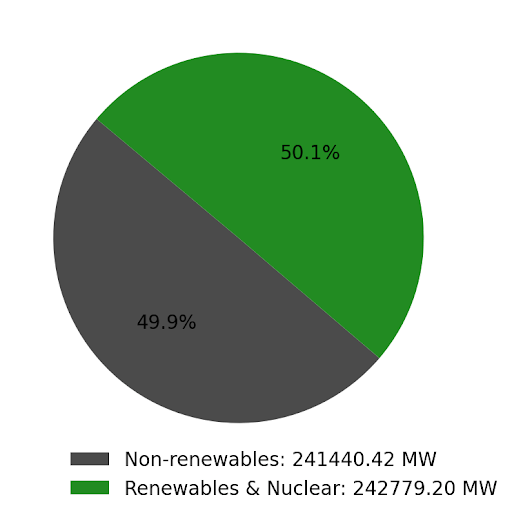

Fig 1. Installed capacity and generation of renewables & nuclear, and non-renewables as of June 2025.[4]
Looking Ahead – Powering India’s 2030 Demand
Electricity demand in India is projected to reach 2,303,637 GWh by 2030, growing at 5.59% annually (based on 2017–2023 trends). To fulfil its Nationally Determined Contribution (NDC) commitments, India must ensure that renewables supply at least 50% of this demand, equating to more than 1,151,818.85 GWh annually by 2030.
This article aims to examine the 2030 energy scenario based on current actual growth rates, alongside a specific scenario focused exclusively on solar energy expansion. To conduct this analysis, several key assumptions have been made:
- Renewables include solar, wind, large hydro, small hydro, and biopower.
- Electricity demand growth is assumed at 5.59% annually, based on the 2017-2023 average [4]. Annual growth rate is taken as an average of the growth rate of each technology from FY 2021-22 to FY 2024-25.
- No transmission losses, curtailments, or efficiency drops are considered.
- Annual generation is calculated as: Generation (GWh) = Capacity (GW) x CUF x 8760.
- CUF/PLF is calculated as the average for each technology from FY 2014-15 to FY 2024-25.
Scenario 1: Business As Usual
Table 1. Key assumptions for scenario 1
Technology | 2025 Installed Capacity (GW) | CUF/ PLF (%) | Annual Growth Rate (%) | 2030 Installed Capacity (GW) | 2030 Generation (GWh) |
Solar PV | 116.25 | 14.83 | 26.56 | 377.46 | 490,366 |
Wind | 51.67 | 18.15 | 6.28 | 70.06 | 111,398 |
Large Hydro | 49.37 | 35.06 | 0.81 | 51.40 | 157,869 |
Small Hydro | 5.10 | 22.86 | 1.60 | 5.52 | 11,056 |
Nuclear | 8.78 | 71.80 | 5.16 | 11.29 | 71,019 |
Bio-Power | 11.59 | 18.50 | 2.42 | 13.06 | 21,168 |
Coal | 221.31 | 59.22 | 1.46 | 237.94 | 1,234,377 |
Oil & Gas | 20.12 | 18.92 | −0.30 | 19.82 | 32,849 |
Total | 484.19 | 786.57 | 2,130,103 |

Fig 2. Installed capacity of various technologies in India for the year 2025 and 2030 (based on projections).
Based on the above assumptions, the total projected energy generation for 2030 stands at 2,130,103 GWh, which falls short of the anticipated electricity demand for that year. Notably, renewable energy installations have already exceeded the 50% mark, reaching this milestone five years ahead of target. However, even with this achievement, the current growth trajectory remains insufficient to close the demand-supply gap by 2030. Furthermore, renewables, including nuclear, are estimated to contribute only 40.5% (862,877 GWh) of the total electricity generation.
Scenario 2: Solar-only expansion
Among all renewable sources, solar has seen the fastest growth, thanks to falling costs, supportive government policies, and large-scale deployment. Between 2021-22 and 2024-25, solar grew at an average rate of 26.56% per year in the country, the highest among all energy sources. Keeping this in mind, considering a scenario where all other sources of power (wind, hydro, nuclear, biopower, coal, oil and gas) remain constant at their June 2025 levels, and only allow solar capacity to expand.
The aim is to determine how much additional solar capacity India would need by 2030 to ensure renewables and nuclear power generate at least 50% of total electricity demand.
Table 2. Key assumptions for scenario 2
Technology | 2025 Installed Capacity (GW) | CUF/ PLF (%) | Annual Growth Rate (%) | 2030 Installed Capacity (GW) | 2030 Generation (GWh) |
Solar PV | 116.25 | 14.83 | 40.74* | 525.59* | 833,821* |
Wind | 51.67 | 18.15 | Constant | 51.67 | 82,152 |
Large Hydro | 49.37 | 35.06 | Constant | 49.37 | 151,627 |
Small Hydro | 5.10 | 22.86 | Constant | 5.10 | 10,212 |
Nuclear | 8.78 | 71.80 | Constant | 8.78 | 55,223 |
Bio-Power | 11.59 | 18.50 | Constant | 11.59 | 18,783 |
Coal | 221.31 | 59.22 | Constant | 221.31 | 1,148,083 |
Oil & Gas | 20.12 | 18.92 | Constant | 20.12 | 33,346 |
Total | 484.19 | 893.53 | 2,333,250 |
Solar Requirement by 2030*
- Required renewable and nuclear generation: 1,151,818.85 GWh
- Fixed renewable and nuclear generation: 317,997 GWh
- Required solar generation: (1,151,818.85 – 317,997) GWh = 833,821 GWh
Using solar CUF of 14.83%, the required installed solar capacity becomes:
Required solar generation in GWh / (14.83 x 8760) = 641.84 GW.
With current solar capacity at 116.25 GW (as of June 2025), India would need an additional 525. 59 GW of solar capacity by 2030, as shown in Fig. 3. This would require the solar capacity to increase with a CAGR of 40.74% from 2025 to 2030.
As per the Central Electricity Regulatory Commission (CERC) regulations, any solar photovoltaic (PV) power project must be designed and operated so that its annual CUF does not fall below 21% [5]. With that, we would require solar capacity: 453.26 GW by 2030, and additional solar capacity required: 337 GW. Complementing this solar expansion, the National Electricity Plan (2023) projects a total energy storage capacity requirement of 411.4 GWh by 2031-32, comprising 175.18 GWh from pumped storage and 236.22 GWh from battery energy storage systems (BESS). [6]
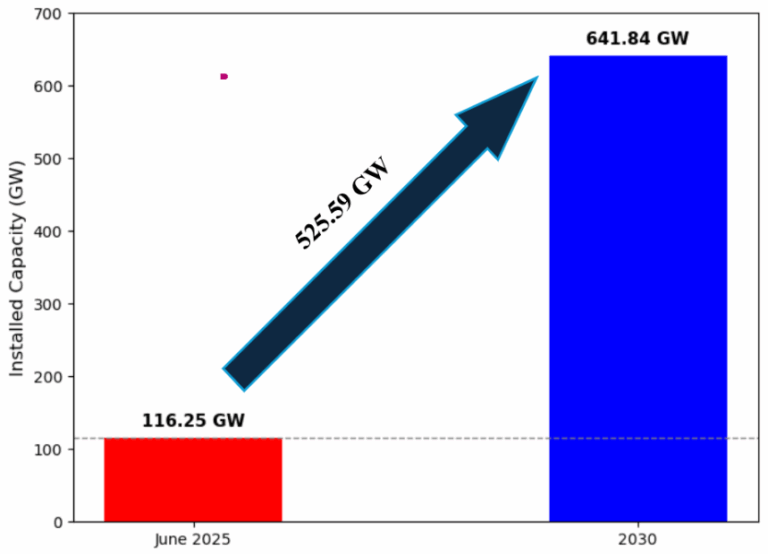
Fig 3. Solar installed capacity to meet 50% renewable energy generation by 2030 in solar-only expansion scenario.
The Path to Clean Power: What’s Needed
Installing capacity is only the beginning. To turn potential into power, India must:
- Expand grid-scale storage and smart grids to stabilize renewable integration.
- Upgrade transmission infrastructure to minimize curtailment and inefficiency.
- Incentivize generation performance, not just installations, through market and policy reforms.
- Encourage state-level innovation, leveraging India’s diverse geography from solar-rich deserts to hydro-ready hills.
This next phase is not just technical, it’s transformational. It demands innovation, investment, and institutional alignment across all levels of governance and industry.
Conclusion: Defining India’s Energy Future
India’s energy story between now and 2030 will define its path toward net zero in 2070. While it has already achieved its capacity target early, the focus now must shift to energy generation rather than energy capacity. Achieving the 50% clean electricity target by 2030 will demand bold investments, innovative technology, and unwavering commitment, not just for policymakers, but for everyone from industry leaders to everyday citizens.
If capacity was our milestone, generation will be our legacy. The world is watching, and India’s clean energy story is just getting started.
References
- India’s Updated First Nationally Determined Contribution Under Paris Agreement, https://unfccc.int/sites/default/files/NDC/2022-08/India%20Updated%20First%20Nationally%20Determined%20Contrib.pdf, Accessed on: 24-09-2025.
- India’s Renewable Rise: Non-Fossil Sources Now Power Half the Nation’s Grid, MNRE, https://www.pib.gov.in/PressReleasePage.aspx?PRID=2144627, Accessed on: 24-09-2025.
- 50 % and rising: Turning India’s renwable capacity milestone into real world power, https://ceedindia.org/50-and-rising-turning-indias-renewable%e2%80%90capacity-milestone-into-real-world-power/, Accessed on: 24-09-2025.
- India Climate and Energy Dashboard, https://iced.niti.gov.in/energy/electricity/generation/capacity, Accessed on: 24-09-2025.
- Central Electricity Regulatory Commission- Draft Renewable Energy Tariff Regulations, 2024, https://cercind.gov.in/2024/draft_reg/DN170224.pdf, Accessed on: 14-10-2025.
- Energy Storage Systems (ESS) Overview, MNRE, https://mnre.gov.in/en/energy-storage-systemsess-overview/, Accessed on: 14-10-2025.