Task Force-SJT, UNDP India and CEED release reports to support just transition planning in Jharkhand
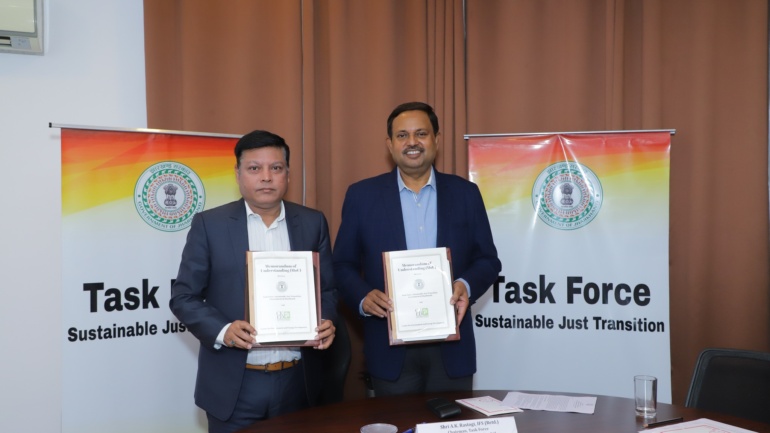
Ranchi, 10 September 2025: To bolster the state’s efforts to become a future-ready economy, the Task Force – Sustainable Just Transition (Government of Jharkhand), United Nations Development Programme (UNDP) India, and the Center for Environment and Energy Development (CEED) jointly released two pathbreaking reports in a workshop today. The two reports, From Dependence to Diversification: Building a Future-Ready Workforce and Pathways of Economic Diversification in Chatra, are prepared by UNDP India and CEED, respectively, under the guidance of the Task Force, which spotlights the state and district-level perspectives on adaptive pathways for diversifying economic activities and catalysing alternative livelihood streams in Jharkhand.
Speaking at the report launch event, Shri Sudivya Kumar, Minister for Urban Development and Housing; Tourism, Art, Culture, Sports and Youth Affairs, Government of Jharkhand, highlighted that Jharkhand’s identity is rooted in jal, jungle, zameen, and in the resilience of its people. Our priority is to harness this wealth responsibly, expand opportunities, strengthen skills, and ensure that development reaches every community. Visionary planning, robust institutions, and people-centred strategies can unlock new opportunities. He praised the initiatives taken by the Task Force through deep dive research and plans, which provide valuable insights in policy planning.
Speaking on the occasion, Shri Aboobacker Siddique P., IAS, Secretary, Department of Agriculture, Animal Husbandry & Co-operative, Jharkhand, stressed on safeguarding livelihoods by ensuring resilience and inclusivity that can transform agriculture into driving equitable growth and long-term sustainability. This can strengthen the local economy and empower communities for a low-carbon future.
The report, ‘From Dependence to Diversification: Building a Future-Ready Workforce’, is based on the analysis of existing challenges and opportunities in 15 districts, and it identifies nine priority sectors – agriculture, construction, services, manufacturing, and renewable energy; shaped by people’s aspirations, policy opportunities and resource availability. By 2050, Jharkhand could cut carbon dioxide emissions by up to 60 percent, reduce pollutants by nearly 57 percent, and prevent 17,800 premature deaths, while saving the economy as much as 6.1 percent of Gross State Domestic Product (GSDP).
Complementing this research, the second report on ‘Economic Diversification Pathways for Chatra’ takes a holistic approach to one of Jharkhand’s largest coal-producing regions that brims with economic opportunities but also has significant vulnerabilities. The report proposes pathways on reducing coal dependence, restoring degraded land, and creating over 37,000 potential jobs across agriculture, renewables, tourism, and forestry-based industries. The study also recommends leveraging DMFT funds and targeted skill development to empower local communities. The Chatra report is one among a series of district-level reports being prepared for 13 coal-rich districts identified by the Task Force.
Underscoring the necessity of economic diversification, Shri A.K. Rastogi, IFS (Retd.), Chairman-Task Force – Sustainable Just Transition, Govt. of Jharkhand, emphasised that the reports form part of a broader people-centric transition process to reduce fossil fuel reliance and build resilient livelihoods. The collective effort, informed by best case studies and evidence-based analysis, can identify key sectors and opportunities that foster inclusive growth, reduce reliance on fossil fuels, and build resilient livelihoods with a forward-looking approach.
Ms. Isabelle Tschan, Deputy Resident Representative, UNDP India, reaffirmed UNDP’s support to the Government of Jharkhand in its vision for a just transition that reaches the last mile; laying key emphasis on the central role of women, youth, and tribal communities in Jharkhand’s just transition journey, ensuring that the shift to a greener and more resilient economy creates real opportunities for the most marginalised and vulnerable
Placing the need of inter-departmental convergence and long-term planning with a bottom-up approach, Shri Ramapati Kumar, CEO of CEED underscored that actionable recommendations can lead towards policy deliberations, strengthen institutions, and enable inclusive growth while leveraging the state’s resource wealth as a foundation for a forward-looking economy.
Shri Ashish Chaturvedi, Head – Action for Climate and Environment, UNDP India, pointed to diverse regional pathways, from agriculture and forest-based enterprises to services and clean industries, for creating dignified and sustainable livelihoods.
The conference also featured two technical discussions. The first session, From Policy to Panchayat: Ground-Level Planning for Livelihoods, was attended by senior officials at various state departments of Jharkhand, such as Mr. Ravi Ranjan, IFS, Additional Principla Chief Conservetor of Forest-CAMPA and Incharge Climate Change cell, Mr. Ravi Ranjan Kumar Vikram, IAS, Labour Commissioner, Department of Labor & Employment, Training & Skill Development; Mr. Kuldeep Choudhary (IAS), Tribal Welfare Commissioner; Ms. Madhavi Mishra, IAS, Director, Horticulture;; Mr. Vishal Sagar, IAS, Director, Department of Industries.
The second panel, From Dependence to Diversification: Reimagining Economies and Employment through Learning from Other States, reflected on cross-state experiences and shared insights from notable speakers from neighbouring states, such as, Shri Bhanu Pratap Singh, CCF (IFS Retd.), Forestry Expert, State Centre for Climate Change, Government of Chhattisgarh, Shri Krishna Rao, Head, NRO-RySS, Andhra Pradesh; Shri Lokendra Thakkar, Director, State Wetland Authority, EPCO, Environment, Government of Madhya Pradesh; Shri Pradeep Hazari, Special Secretary cum Adviser, Department of Agriculture, Jharkhand; Smt. Mahua Chaudhary, State Program Manager, Governance, JEEVIKA, Bihar,
The event concluded with the note, as Jharkhand prepares for a future that demands resilience and innovation, these reports will serve as critical tools to guide policy, empower communities, and unlock new opportunities. The workshop was attended by senior government officials from Jharkhand and neighbouring states, representatives from industries, PSUs, business associations, think tanks, and civil society organisations.
Notes to the Editor:
Weblink of Reports: https://hosturl.info/CtrkSC