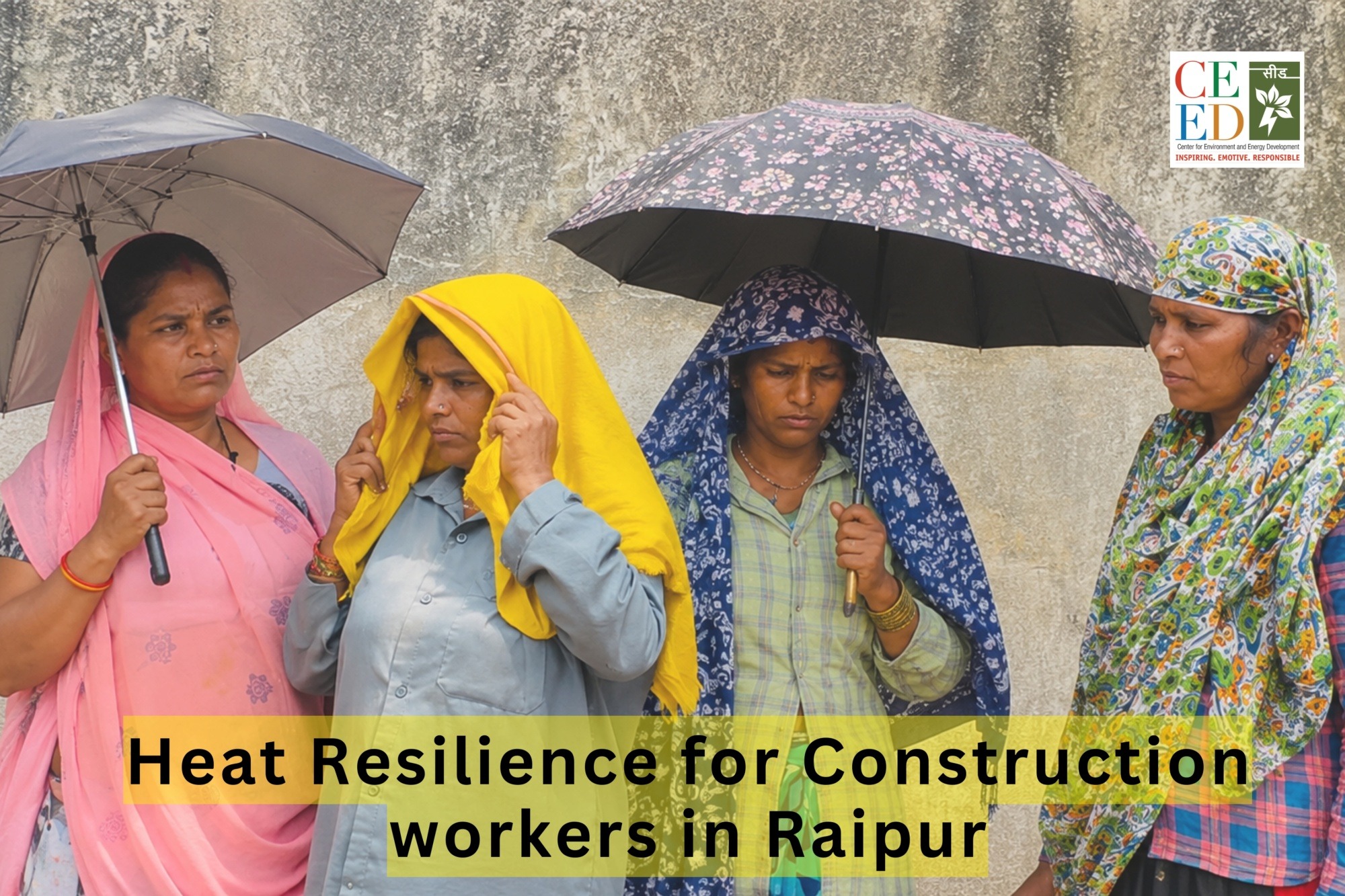
Heat Resilience for Construction workers in Raipur
Shatabdi Sinha; Dr. Devyani Sharma
24 June, 2026
Introduction
Raipur is experiencing a rapid real estate and infrastructural expansion. However, this urban transformation is unfolding against a challenging backdrop: a localized sub-tropical climate rapidly shifting under the dual pressures of regional warming and the Urban Heat Island (UHI) effect. With summer temperatures regularly breaching 44°C, the city’s construction sites have become arenas of acute microclimatic vulnerability.
For the outdoor workforce, the construction environment presents a compounded thermal hazard. Workers face high ambient air temperatures, intense solar radiation, metabolic heat generated by heavy labor, and radiant heat emitted from high-thermal-mass building materials like concrete, steel, and asphalt.
Occupational Heat Stress
Heat stress occurs when the human body is unable to dissipate excess heat generated internally through physical activity and externally through environmental exposure. Construction workers are particularly vulnerable because they often work on exposed sites with minimal shade, operate heavy machinery, carry construction materials, and wear protective equipment that can restrict heat dissipation. Prolonged exposure can lead to dehydration, heat exhaustion, heat cramps, and, in severe cases, life-threatening heat stroke.
To design effective interventions, we must first understand the biophysical metrics governing human thermal comfort. While dry-bulb temperature is a common reference point, it fails to capture the true physiological strain on a construction worker. Urban microclimate assessments rely more accurately on the Wet-Bulb Globe Temperature (WBGT) index, which integrates:
- Ambient Temperature: Ambient temperature refers to the temperature of the surrounding air and is one of the primary determinants of thermal stress. Higher ambient temperatures reduce the body’s ability to dissipate metabolic heat, increasing the risk of heat-related illnesses among outdoor workers.
- Humidity: Relative humidity influences the effectiveness of evaporative cooling through sweating. High humidity levels reduce sweat evaporation from the skin surface, impairing the body’s natural thermoregulatory mechanisms and exacerbating heat stress even when air temperatures are moderate.
- Wind Speed: Wind speed plays a crucial role in convective heat exchange between the human body and the surrounding environment. Increased airflow enhances heat dissipation through convection and evaporation, thereby reducing perceived heat stress and improving thermal comfort for workers.
- Radiant Heat Flux: Radiant heat flux represents the transfer of thermal energy from surrounding surfaces and solar radiation to the human body. In outdoor construction environments, direct solar exposure and heat emitted from materials such as concrete, asphalt, and metal surfaces can substantially increase the thermal load experienced by workers, often beyond what is indicated by air temperature alone.
When the WBGT exceeds critical thresholds (typically 28°C to 30°C for heavy labor), the human body’s core thermoregulatory mechanisms begin to fail. Evaporative cooling through sweat becomes highly inefficient in stagnant microclimates. This leads to a rapid rise in core body temperature, drastically escalating the risks of heat exhaustion and fatal heat strokes, while severely depressing labor productivity.
Heat Resilience Survey- Construction Workers
This Survey of 154 construction workers was conducted to assess heat resilience and the impacts of rising temperatures at construction sites. The findings show that 99.4% of workers believe summers have become hotter in recent years, highlighting widespread awareness of increasing heat. Most respondents (87.7%) work 4–8 hours daily, while 12.3% work 8–12 hours. Although 90.3% reported having access to shade, the majority still experience heat-related health issues, with 76% reporting extreme thirst, followed by headaches (16.2%), dizziness (3.2%), weakness (1.9%), and only 2.6% reporting no health problems. While only 4.5% had experienced heatstroke and 11% felt extreme heat affected their work ability, awareness of official heatwave alerts was very low (13.6%). Workers identified drinking water (151 responses), shade (146), rest breaks (143), and protective gear (136) as the most important measures to improve workplace safety, with fewer requesting medical support (32) and changes in working hours (8). Overall, the survey indicated that ensuring access to basic heat-protection facilities and improving heatwave awareness are essential for enhancing the safety, health, and productivity of construction workers in increasingly hot urban environments.
Interventions to tackle extreme heat
Spatial and governance based strategies to alter site-level thermodynamics:
- Dynamic Shading Configurations: Rather than relying on static, poorly ventilated plastic tarps, sites should deploy high-albedo, UV-reflective canopy materials over active work zones
- Passive Heat Sinks: Drawing inspiration from traditional Indian vernacular architecture, decentralized, temporary cooling nodes should be deployed
- Misting Plazas: Integrating pressurized micro-misting systems with high-thermal-mass evaporative cooling surfaces can lower localized temperatures by up to 5°C to 7°C within rest areas
- Occupational Health Accountability: Requiring sites to maintain shade-to-worker ratios, mandatory hydration breaks, and verified physiological acclimatization periods for new workers
- Smart PPE Kits: Partnering with industrial bodies to provide subsidized cooling vests and ventilated gears to the workers
At the policy level, the implementation of occupational heat standards and city-level Heat Action Plans must explicitly recognize construction workers as a high-risk population. Heat resilience should be viewed not merely as a labor welfare issue but as a cornerstone of climate adaptation and sustainable urban development.
Conclusion
Integrating heat resilience into Raipur’s urban growth requires a structural shift in building codes and municipal bylaws. We must treat thermal safety not as an operational variable, but as a rigid infrastructural metric.
By binding heat-resilient site protocols into building permit approvals and master-planning frameworks, Raipur can pioneer a model for mid-sized, rapidly urbanizing tropical cities. Protecting the health of our construction workforce is a foundational prerequisite for building sustainable and equitable urban futures.
What specific microclimatic challenges or structural bottlenecks have you observed when trying to implement cooling interventions on active municipal job sites?
References
- Tiwari, Purvi & Shrivastava, A. & Dave, A.. (2023). Investigation of Heat Stress among Greenhouse Workers in Chhattisgarh, India. International Journal of Environment and Climate Change. 13. 1927-1935. 10.9734/ijecc/2023/v13i113350.
- Strengthening Heat Resilience in Cities – Insight from India
- Towards heat-resilient buildings in Indian cities- C40 Cities Climate Leadership Group
- International Labour Organization (ILO). (2024). Heat at work: Implications for safety and health. Geneva: International Labour Organization.
- Global Center on Adaptation. (2024). Heat Stress: The Silent Killer in Indian Cities.