Heat, Gender, and Governance: Building Climate Resilience in Eastern India
Author: Hansa Sinha
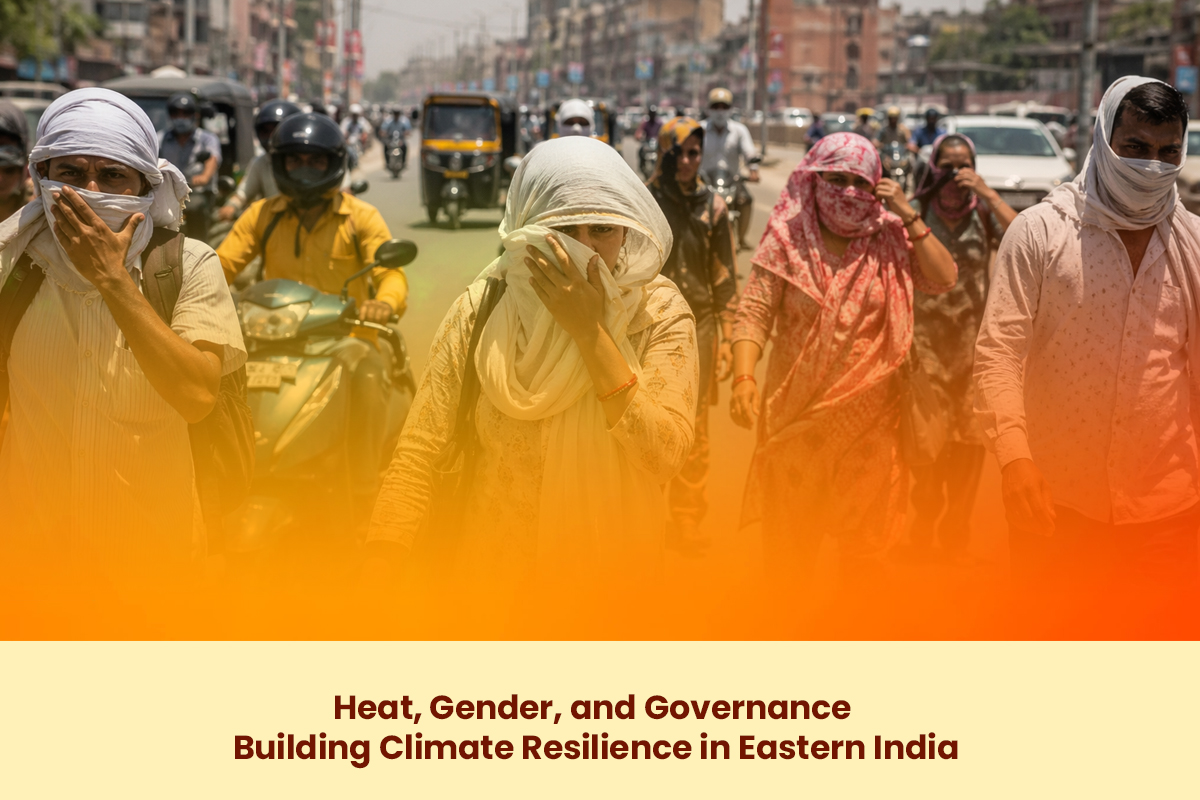
The summer of 2026 has underscored the growing urgency of addressing climate change and its increasingly visible impacts. Record-breaking temperatures and prolonged heatwaves have exposed millions to severe heat stress, disrupting livelihoods, threatening public health, and turning climate change into an immediate lived reality.
While extreme heat affects the entire population, its impacts are experienced unequally. Climate-induced heat stress interacts with existing social and economic inequalities, leaving certain groups more vulnerable than others. Among these groups, women bear a disproportionately high burden. The IPCC Sixth Assessment Report highlights that climate-related vulnerabilities are closely linked to gender inequalities, with women facing heightened risks due to unequal access to resources, healthcare, decision-making power, and adaptive infrastructure.
As heat stress intensifies across Eastern India particularly states such as Jharkhand and Chhattisgarh, there is a need to move beyond gender-neutral approaches towards gender-responsive heat governance that recognises the differentiated impacts of extreme heat and actively integrates women’s needs, experiences and leadership into climate action.
Gendered Dimensions of Heat Vulnerability
Although extreme heat affects all, evidence suggests that women often bear an unequal burden of heat stress. Women frequently shoulder multiple roles and responsibilities, from managing household chores to performing caregiving duties to participating in paid employment. Limited access to cooling and protective infrastructure combined with labour-intensive and domestic work such as cooking, water collection, household management, caring for children, sick and older people places hidden heat burden on women.
Many of these tasks are often performed by women during the hottest hours of the day, resulting in higher exposure to heat and increased risk of heat-related issues. Extreme heat can lead to dehydration, fatigue, dizziness, and adverse reproductive and menstrual health outcomes, especially among women in rural areas and high heat vulnerability districts. Heat also increases the risk of miscarriage, stillbirth, and can worsen mental health while physiological differences further heighten their vulnerability, exacerbating existing gender-based health and economic inequalities.
This heightened vulnerability is shaped not only by biological factors but also by the gendered division of labour, access to resources and unequal social roles that structure everyday life. Consequently, heat is not merely an environmental hazard for women; rather, it is also a social and economic risk that reinforces existing gender inequalities.
Gender, Heat Risk and Policies in Eastern India: Jharkhand and Chhattisgarh
Women play a significant role in the economies of both Jharkhand and Chhattisgarh, contributing substantially to productive work while simultaneously undertaking the majority of unpaid household and caregiving responsibilities. This dual burden significantly increases their exposure to extreme heat across both economic and domestic settings.
States | Female Labour Force participation (2025) under 15- 59 years | Heat Risk Index and Trends |
Jharkhand | Total – 46.6%
Rural – 53.3% | CEEW Heat Risk Index – 16 districts (67%) under Moderate Risk; 8 districts (33%) under High Risk.
Trends – Nearly 590 heatwave days recorded between 1990 and 2024, representing almost a 300% increase in heatwave occurrence. |
Chhattisgarh | Total – 64.7%
Rural – 72.4% | CEEW Heat Risk Index – 12 districts (44%) under Moderate Risk; 15 districts (56%) under High Risk.
Trends – Districts across Chhattisgarh are highly vulnerable to extreme heat due to the combined impacts of rising temperatures and underlying socio-economic and health vulnerabilities, and limited access to adaptive resources. |
However, despite this increased workforce participation, many women continue to be concentrated in climate-sensitive sectors, particularly agriculture and informal employment, where they are exposed to prolonged heat and limited social security which hampers their ability to cope with and recover from climate-induced shocks. At the same time, this concern is amplified by escalating heat risks across both states. According to the heat risk index and heat trends, the majority of the districts in both the states fall under the high heat risk category. This highlights even greater risk for workers engaged in outdoor, agriculture and allied activities further deepening the existing inequalities.
Both states have initiated several measures to address the impacts of extreme heat through climate and public health planning, policies and programmes such as Jharkhand State Action Plan for Climate Change and Human Health 2022 – 2027 (SAPCCHH), Jharkhand Heat Wave Action Plan, Chhattisgarh State Action Plan for Climate Change and Human Health 2022 – 2027 (SAPCCHH), Chhattisgarh Heatwave Action Plan 2018. While the above policy frameworks acknowledge vulnerable populations including women, explicit recognition of women’s differentiated heat vulnerabilities remains limited. This represents an important opportunity to strengthen future heat governance through a gender-responsive lens.
These conditions highlight the need to integrate gender considerations into Eastern India’s emerging heat governance framework before heat risks intensify further. As both states continue to strengthen climate resilience and develop heat governance frameworks, gender considerations can be systematically embedded within policy frameworks, heat action plans, district-level adaptation strategies, public health systems, and local governance mechanisms. Prioritizing a gender-responsive approach from the very beginning will help establish a long-term vision for inclusive and equitable heat governance in the state.
What is Gender-responsive Governance? “Gender-responsiveness means paying attention to the unique needs of females, valuing their perspectives, respecting their experiences, understanding developmental differences between girls and boys, women and men and ultimately empowering girls and women. – UNICEF ” Gender-responsive heat governance, therefore, refers to the integration of gender considerations into heat related plans, leadership and policies recognising the importance of differentiated response. This approach encompasses two key dimensions. First, it requires embedding gender-responsive measures into governance frameworks such as policies and plans including heat action plans, cooling infrastructure, early warning systems, social protection mechanisms, public health responses and others. Second, it requires meaningful participation of women in the decision-making and governance process by providing leadership opportunities, recognising them not merely as beneficiaries but as critical agents of resilience. Such an approach improves policy effectiveness, strengthens social equity, and enhances resilience outcomes. When gender considerations are integrated into heat action plans, early warning systems, and public health responses, interventions become more targeted and inclusive, eventually reducing mortality and morbidity among vulnerable populations, particularly women. It also strengthens institutional accountability by addressing structural inequalities in decision-making and resource allocation. |
Global Momentum: From Gender-neutral to Gender-responsive Governance
Global climate discussions have gradually evolved from viewing women primarily as vulnerable populations to recognising their critical role in building climate resilience and driving climate actions. Increasingly, international climate frameworks emphasize the importance of gender-responsive approaches.
Recent international climate negotiation COP 30, reinforced this shift through adoption of the Belem Gender Action Plan for mainstreaming gender considerations across climate mitigation, adaptation, finance, technology, and capacity-building, seeking to strengthen women’s leadership in climate action.
This shift reflects growing recognition that governance is most effective when it addresses structural inequalities and incorporates diverse perspectives into decision making.
Lessons from Cities Introducing Gender-responsive Governance
These case studies from Freetown, Surat and Indonesia illustrate complementary dimensions of gender-responsive governance. Together they demonstrate how integrating gender considerations will look like.
Way Forward
As Jharkhand and Chhattisgarh advances its climate resilience agenda and develops its heat governance framework, it has a timely opportunity to embed gender considerations from the outset rather than as an afterthought. Drawing on lessons from Surat , Freetown and Indonesia gender-responsive approaches requires integrating gender-responsive measures across heat action planning, including sex-disaggregated data collection, targeted public health recognition and interventions, accessible cooling infrastructure, social protection for women in climate-sensitive occupations, and heat early warning systems that effectively reach women through community networks.
Equally important is ensuring that women are not viewed solely as vulnerable beneficiaries but as active participants in decision-making. Strengthening the leadership of women within local governance, institutions, community organisations, and climate planning processes can improve the effectiveness, inclusiveness, and sustainability of heat adaptation efforts. As heat risks continue to intensify, adopting a gender-responsive approach will not only reduce vulnerabilities but also build more equitable and resilient communities across Jharkhand and Chhattisgarh.