|
Jharkhand, once known as the “heartland of India’s energy,” is now reimagining its future as a renewable energy powerhouse. For decades, the state’s economy and infrastructure were built upon the extraction of iron ore, minerals, and other resources that powered India’s industrial growth. But as the global energy transition accelerates and India commits to achieving 500 GW of non-fossil fuel capacity by 2030, Jharkhand faces a crucial turning point: how to move from fossil dependency to clean, inclusive, district-led energy leadership.
In collaboration with the Centre for Environment and Energy Development (CEED), the Government of Jharkhand recently released a pioneering report titled “Powering Progress: Unlocking Jharkhand’s Renewable Energy and Storage Potential”. The report takes a high-resolution approach, mapping renewable and storage potential across all 24 districts and 264 blocks, a first-of-its-kind framework for local energy planning in the state.
The findings are transformative. Jharkhand holds a total renewable energy potential of about 66 GW, comprising 46 GW from renewables and 20 GW from pumped hydro energy storage (PHES). Yet, as of 2024–25, its installed renewable capacity stands at just 434 MW, roughly 7% of its energy mix. Bridging this gap is not simply a technical task; it’s a governance challenge that will depend on how each district mobilizes its resources, institutions, and communities.
From Coal Strength to Clean Resilience
Jharkhand’s rich energy heritage has long powered India’s growth and that same strength can now fuel its clean energy future. With strong industrial infrastructure, skilled workers, and established power networks, the state is uniquely positioned to lead India’s next phase of energy progress.
Embracing renewables is not about moving away from coal, but about building on Jharkhand’s legacy to create a diverse, future-ready energy ecosystem. As global markets evolve and renewable technologies become more affordable, clean energy offers the state a competitive advantage – ensuring energy security, stable growth, and new employment opportunities across districts.
The latest RE assessment reveals that even by tapping into 25% of its renewable potential, Jharkhand could generate more clean power than it currently consumes, showcasing the scale, feasibility, and promise of a greener, more resilient energy future.
The Power of District-Level Leadership
What makes this study exceptional is its focus on decentralized energy leadership. Instead of viewing renewables as large, top-down projects, it disaggregates the state into district-level zones of opportunity. Each district possesses unique characteristics, from land availability and solar irradiation to hydrological profiles and biomass yields, making localized planning essential.
Solar Energy: Jharkhand’s Brightest Prospect
Solar power forms the backbone of the state’s renewable transition, accounting for over 41 GW of potential capacity. This includes:
- Utility-scale solar farms on underutilized land
- Rooftop solar in urban and industrial clusters
- Agrivoltaic systems combining agriculture with solar power
- Floating solar on water bodies like Chandil Dam
- Concentrated Solar Power (CSP) for hybrid applications

Districts such as Giridih, Ranchi, Gumla, Palamu, and Chatra emerge as frontrunners due to high solar radiation and accessible land. These districts could anchor solar-energy corridors, linking generation to nearby industrial demand centers.
Highlight: Jharkhand’s entire solar potential could be achieved using just 1.1% of its total land area, underscoring the state’s ability to balance clean energy expansion with ecological and agricultural priorities.
Tapping Hydropower and Storage Synergies
Complementing solar, Jharkhand’s 4.1 GW hydropower potential and 20 GW PHES (Pumped Hydro Energy Storage) capacity offer a reliable foundation for grid balancing and round-the-clock renewable supply. Districts like Simdega, Bokaro, and West Singhbhum lead in PHES potential.
Leveraging Jharkhand’s hilly terrain and abundant water resources, the state holds a unique advantage that few others possess. Pumped hydro, in particular, offers Jharkhand the ability to meet peak power demand efficiently, ensuring round-the-clock reliability as renewable energy expands.
By integrating storage with renewable clusters, Jharkhand can stabilize its grid, minimize curtailment losses, and create long-duration energy backup, a critical enabler for industrial consumers transitioning away from fossil-based captive power.
Waste-to-Energy and Biomass: Power from the Ground Up
Jharkhand’s biomass and waste-to-energy potential of 1 GW highlights a unique synergy between energy and waste management.
Forest-rich districts such as Gumla and West Singhbhum can utilize forest residues and crop waste, while Ranchi and Dhanbad can leverage municipal solid waste. These technologies not only provide decentralized energy but also strengthen circular economy linkages, reducing landfill dependency and enhancing rural incomes.
Cluster-Based Green Transition Strategy
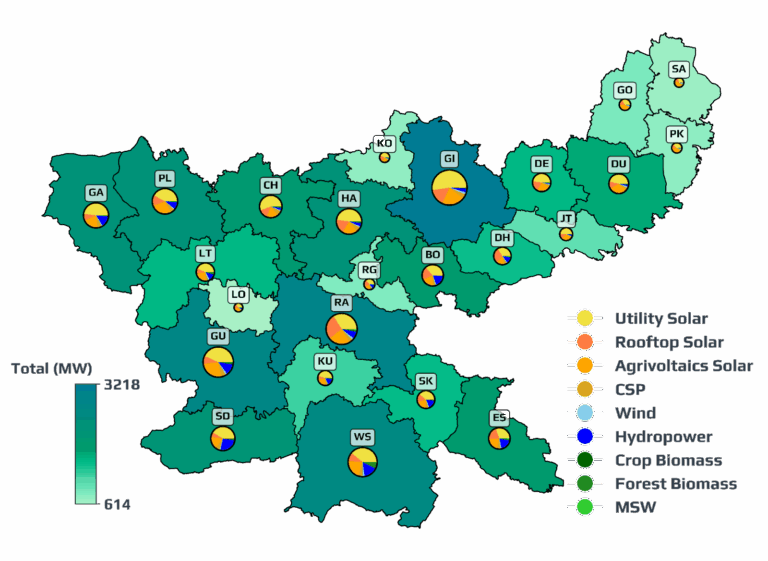
Fig 2. Installed capacity of various technologies in India for the year 2025 and 2030 (based on projections).
Jharkhand’s renewable energy plan adopts a cluster-based approach to drive a balanced, low-carbon transition
- Cluster 1: Ranchi, Ramgarh, Hazaribagh – High potential, strong industrial base.
- Cluster 2: Giridih, Dhanbad, Bokaro – Industrial hub for solar and wind expansion.
- Cluster 3: West & East Singhbhum, Saraikela-Kharsawan – Focus on large-scale and industrial decarbonisation.
- Cluster 4: Deoghar, Dumka, Godda – Solar and biomass for rural access.
- Cluster 5: Palamu, Garhwa – Decentralised renewable systems in later phases.
This phased rollout ensures high-impact deployment, inclusive growth, and progress toward Jharkhand’s clean energy goals.
A Phased Pathway to a Greener Jharkhand
Jharkhand’s clean energy journey is not a departure from its industrial past, but an evolution of it; from powering India through its minerals to illuminating its future through renewables. By focusing early efforts on high-impact clusters, the state is building a strong foundation for sustainable growth that is regionally balanced, inclusive, and forward-looking. With its natural advantages, skilled workforce, and policy ambition, Jharkhand has everything it needs to emerge as India’s clean energy powerhouse, driving resilience, prosperity, and progress for decades to come.