Atiya Afreen, Niva Mishra |
Introduction & Background
The monsoon is more than just a season in India – it’s the country’s heartbeat! From the deserts of Rajasthan to the lush slopes of the Western Ghats, rains indicate whether fields thrive or fail, whether rivers flow freely or run dry, whether millions eat well or go hungry. Nearly 60% of India’s farmland is rain-fed, making the southwest monsoon not just a weather phenomenon, but the foundation of India’s food security, economy, and social stability.
But this lifeline is now becoming unpredictable. Once seen as nature’s most reliable rhythm, the monsoon is shifting under the weight of a warming planet. Delayed arrivals, erratic bursts, and prolonged dry spells are reshaping how—and where—rain falls. In a country where half the population still depends directly on agriculture, every shift in the clouds reverberates through villages, cities, and markets alike.
As India faces the reality of climate extremes—floods one month, droughts the next—understanding the forces driving this volatility has never been more urgent. This piece unpacks the science, the human impact, and the road ahead in navigating India’s most defining climate challenge: the monsoon.
Overview of 2025’s Weather from Extremes with record-breaking rainfall to severe drought
The year 2025 stands out as a historic outlier in India’s climate history. The country experienced its wettest May since 1901, recording 126.7mm of rainfall which is more than double the usual. Kerala saw the monsoon’s onset as early as May 24, the earliest in over a decade, quickly followed by the fastest ever advance to Mumbai (in just two days instead of the usual ten), and the earliest onset for several states in 25 years. Central India witnessed its rainiest May ever, leading to local flooding and crop losses.
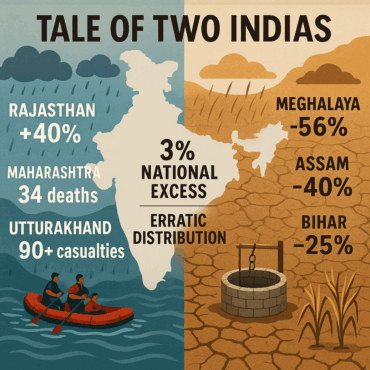
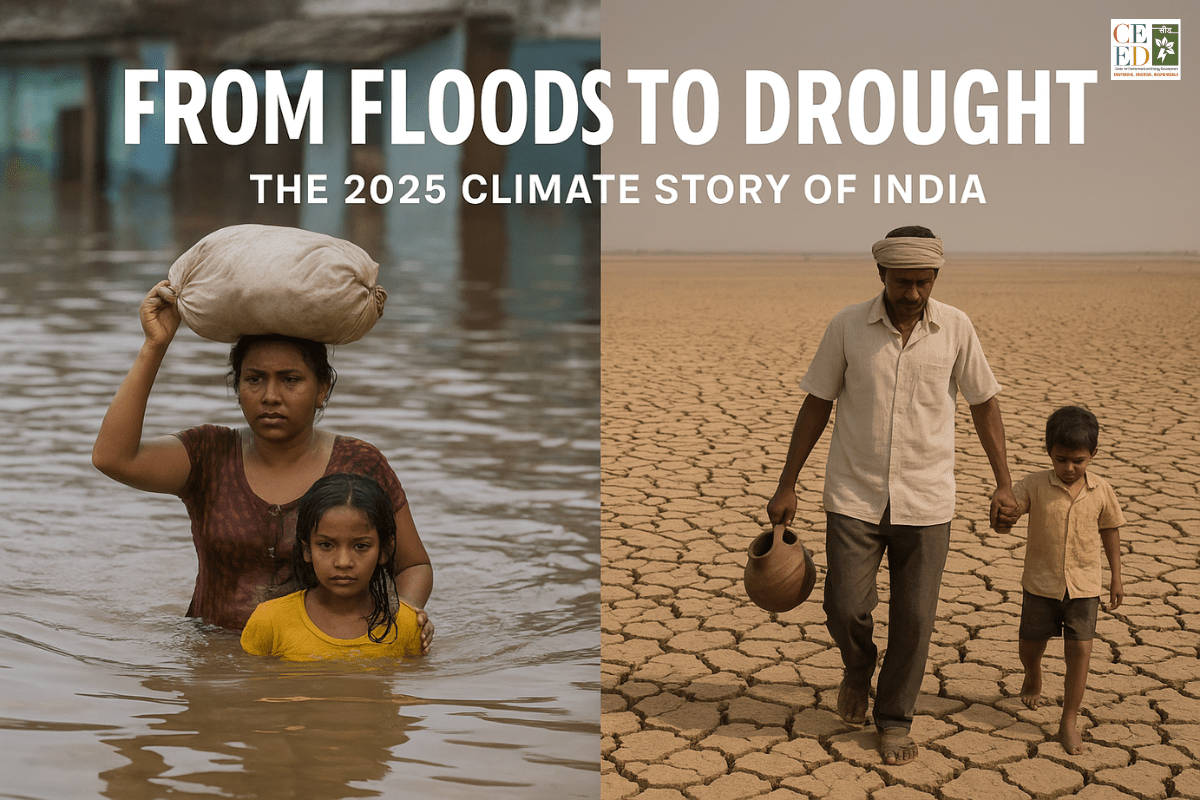
Figure: Rainfall scenario (flood and drought)
Yet, this abundance was short-lived. By August, a sharp reversal struck: nearly 19% of the country was experiencing drought or drought-like conditions despite the early excess. Severe rainfall deficits gripped wide regions—parts of Ladakh, Arunachal Pradesh, Bihar, UP, Punjab, and the Northeast suffered 30-70% below-normal rainfall and dwindling soil moisture, triggering crop stress and water shortages. This whiplash from record rainfall to exceptional drought within the same season is virtually unprecedented in the instrumental record.
India saw a 3% excess rainfall as of August 5, 2025. However, rainfall was erratically distributed across states.
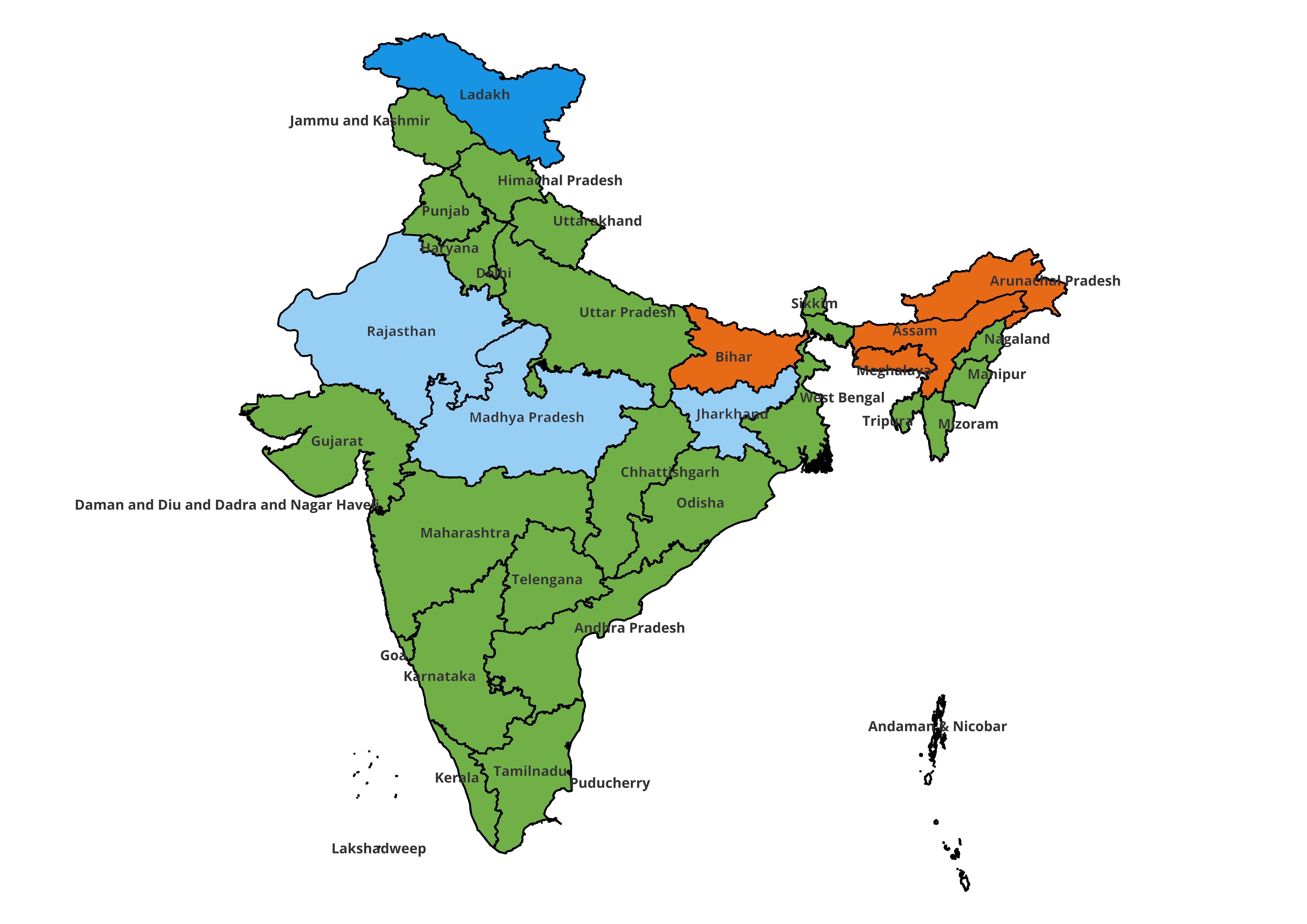

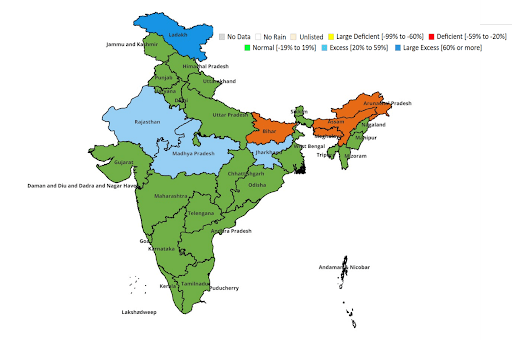

Figure – Map showing State wise Rainfall Scenario (Excess to deficit) in the year 2025 (Source: IMD)

Figure – Aug 2025 Rainfall Departure (Source – IMD)
Causes Behind the Extreme Weather
India’s 2025 weather extremes stem from interconnected global and local factors that have fundamentally altered traditional climate patterns.
a. Climate Change and Monsoon Disruption
- Global Warming’s Impact: Global temperatures exceeded 1.5°C above pre-industrial levels in 2024, with India recording its second-highest January temperature since 1901. Extreme rainfall events (>150mm/day) increased by 75% in central India (1950-2015). Dry spells during monsoon increased by 27% (1981-2011 vs 1951-1980). Nearly half of seasonal rainfall now falls within just 20-30 hours, creating dangerous dry gaps.
- Regional Redistribution: Kerala, the Northeast, and East Central India face declining rainfall, while North Karnataka, Maharashtra, and Rajasthan are seeing increases. A warmer atmosphere holds more moisture, triggering intense downpours followed by prolonged dry spells, the pattern behind 2025’s flood-to-drought whiplash.
b. Atmospheric Patterns and Ocean Oscillations
- ENSO Neutral Conditions: The 2025 monsoon unfolded under neutral El Niño-Southern Oscillation conditions, removing predictable climate influences. Without typical El Niño (weakening) or La Niña (strengthening) effects, other factors gained prominence, including a transitioning Indian Ocean Dipole that favoured regional rainfall.
- Madden-Julian Oscillation (MJO): The MJO was in phases 4-6 during May 2025,the most dominant stages enhancing cloud formation over Arabian Sea and Bay of Bengal. This contributed to the unprecedented early and intense monsoon onset.
c. Local Environmental Degradation
- Rapid Urbanisation: Rapid urbanization has intensified weather extremes through concrete expansion and loss of natural cooling systems.
- Forest Loss Acceleration: Annual forest loss increased significantly from 2001-2018, with Northeast India most affected. Climate velocities reaching 97 km/year force rapid ecosystem changes, reducing natural climate regulation and flood control.
- Infrastructure Failures: Over 70% of Indian cities lack proper stormwater drainage. Outdated systems compound climate impacts.
Impacts Across Sectors
The 2025 weather extremes have created cascading impacts across India’s interconnected socio-economic system, affecting lives, livelihoods, and long-term development.
aHuman Cost: Lives Lost, Displacement, and Health Impacts
- Mounting Casualties: India accounts for 10% of global extreme weather deaths, with 2,483 fatalities in 2023 alone. The 2025 toll has been equally severe: : 308 deaths in Madhya Pradesh (lightning/floods), 273 fatalities Uttar Pradesh (heatwaves/lightning), 263 deaths in Bihar (including 250 from lightning), and 90 killed with 50+ missing in Uttarakhand flash floods.
- Mass Displacement: Climate-driven displacement hit a critical peak in 2025, with 5.4 million internal displacements, the highest since 2013. India could face 45 million climate migrants by 2050, nearly triple current numbers. In Bihar, 80% of flood-affected farmers migrate to states like Punjab and Delhi, fragmenting communities.
- Health Crisis: Extreme weather is fuelling disease outbreaks through contaminated water and disrupted sanitation. Heat stress intensifies as temperatures soar past 40°C, while flooded hospitals in several cities cripple healthcare precisely when it’s most needed.
b.Economic Losses: Massive Financial Toll
- Staggering Costs: From 1993-2022, extreme weather conditions cost India $180 billion, ranking it sixth globally for climate losses. In 2023 alone, losses reached $12 billion. Urban flooding costs $4 billion annually, projected to hit $30 billion by 2070.
- Agricultural Devastation: Over 1.58 lakh hectares were damaged across 13 states (April-July 2025). Maharashtra lost 90,000+ hectares, while drought caused ₹35,162 crore losses and a 9% production drop in June 2025, threatening 1 million jobs in the tea industry.
- Infrastructure Destruction: Himachal Pradesh reported ₹2,007 crore infrastructure damage and ₹1,394.67 crore losses in power systems. Motor insurance claims spiked 33% during monsoon season, and ₹3,200 crore was paid out in crop insurance to 30 lakh farmers.
c. Social Implications: Migration, Conflicts, and Service Disruption
- Climate Migration Crisis: In Bihar, families losing ancestral homes are split – men migrate to Punjab and Delhi for work while women and children remain displaced, straining fragile urban systems.
- Water Conflicts: Drought-hit regions face severe groundwater depletion—Rajasthan alone extracts 16.74 billion cubic meters annually. Families abandon farming as wells dry, while flood regions struggle with contaminated water and damaged infrastructure.
- Education and Healthcare Disruption: Regular school closures affect millions of students. Healthcare systems strain under flooded facilities and infrastructure damage, creating long-term development impacts as communities struggle to recover from repeated climate shocks.
d. Environmental Damage: Ecosystem Collapse
- Soil and Biodiversity Loss: Flooding strips away fertile topsoil that takes decades to regenerate. Alternating floods and droughts worsen ecosystem decline. In Himachal Pradesh, extreme weather killed 954 livestock in 2025, indicating deepening stress.
- Habitat Destruction: Annual forest loss accelerated between 2001-2018, hitting Northeast India the hardest. Cities like Mumbai (80% wetland loss) and Bengaluru (79% wetland loss) have eliminated natural flood buffers, intensifying future extreme events.
Preventive & Preparedness Measures
India has comprehensive disaster frameworks but needs enhanced strategies to address emerging climate realities.
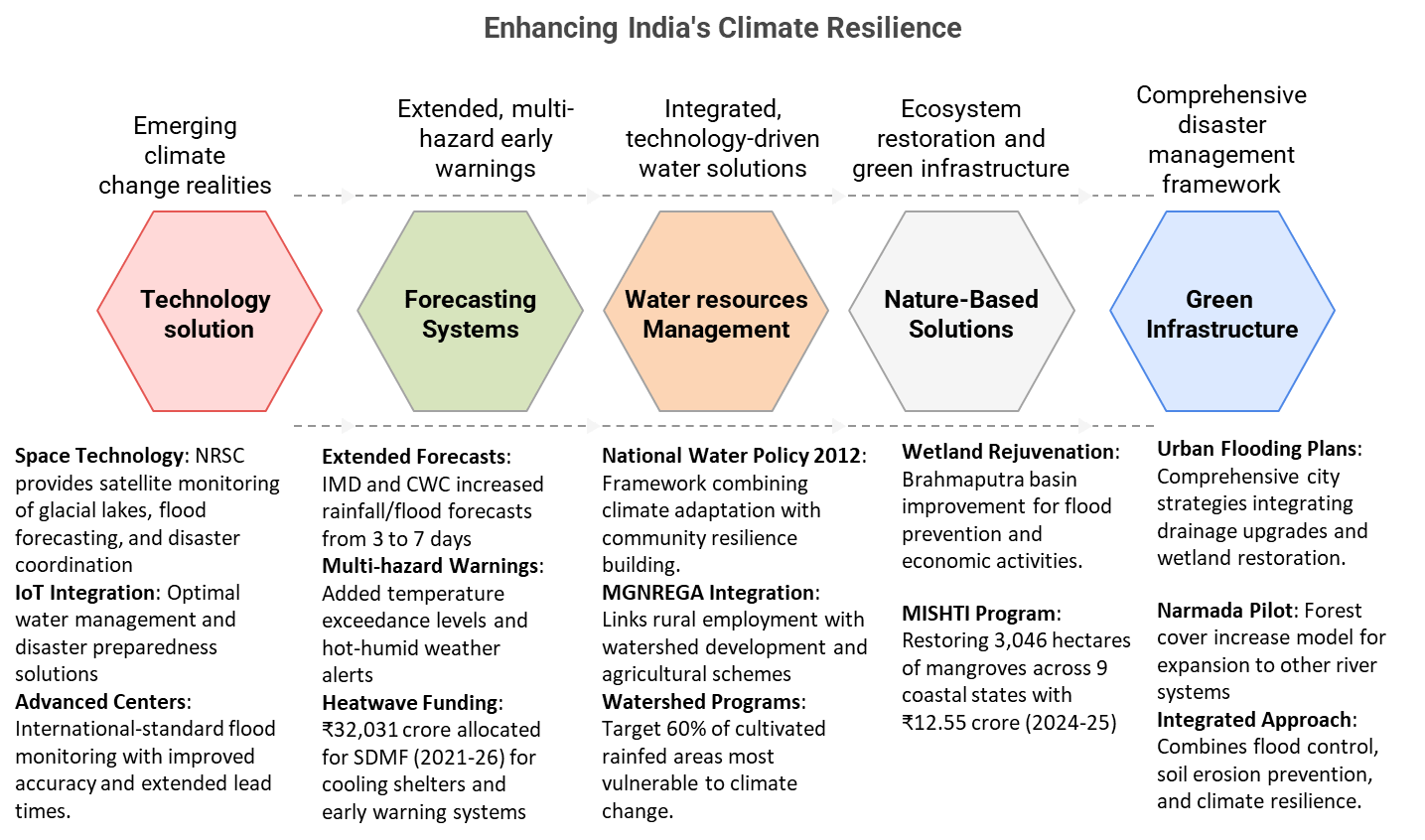
These measures represent India’s multi-layered approach combining institutional frameworks, technological solutions, and nature-based interventions for comprehensive climate preparedness.
The Way Forward : Building a Climate-Resilient India
India’s resilience to escalating climate extremes depends on bold policy reform, cutting-edge technological innovation, and strengthened grassroots action. The National Adaptation Plan must drive sector-wide preparedness while keeping sight of the net-zero 2070 target.
Key Priorities:
- Smarter Forecasting: Deploy AI-driven weather prediction and early warning systems for faster, local-level response.
- Ecosystem Restoration: Invest in large-scale wetland revival, forest regeneration, and watershed protection to rebuild natural climate buffers.
- Sustainable Cities: Redesign urban spaces with green infrastructure, climate-proof housing, and modern stormwater systems.
- Resilient Communities: Expand Pradhan Mantri Fasal Bima Yojana (PMFBY) coverage, promote diversified livelihoods, and integrate climate education into schools and community programs.
The events of 2025 are a stark reminder that India has the capacity for large-scale mobilization, but resilience cannot be built on ad-hoc responses. Lasting security against climate shocks will require sustained political will, cross-sector coordination, and empowered citizens driving change from the ground up.
References
- https://www.mahyco.com/indian-agricultures.html
- https://www.downtoearth.org.in/climate-change/may-mayhem
- https://www.downtoearth.org.in/agriculture/around-19-of-india-under-drought-drought-like-conditions-despite-above-normal-rainfall-in-early-monsoon-dews-data
- https://sandrp.in/2025/06/03/district-wise-rainfall-in-pre-monsoon-2025-season-in-india/
- https://timesofindia.indiatimes.com/city/guwahati/drought-like-situation-in-5-dists-sarma/articleshow/122770441.cms
- https://mausam.imd.gov.in/backend/assets/aiwfb_pdf/b738bb6933943fb70c719e12eca314f6.pdf
- https://economictimes.indiatimes.com/news/india/4-river-sites-in-severe-flood-situation-11-above-warning-level-says-govt-water-body/articleshow/122319795.cms
- https://waterresources.assam.gov.in/portlets/flood-erosion-problems
- https://eprajournals.com/pdf/fm/jpanel/upload/2025/August/202508-11-023624
- https://travelentice.com/flash-floods-in-himachal-pradesh-uttarakhand-2025/
- https://www.ceew.in/blogs/predicting-erratic-unseasonal-monsoon-and-rainfall-patterns-in-a-changing-climate
- https://www.pib.gov.in/PressNoteDetails.aspx?id=154892&NoteId=154892&ModuleId=3
- https://www.frontiersin.org/journals/sustainable-cities/articles/10.3389/frsc.2023.1308684/full
- https://carbonimpacts.info/article/extreme-events-in-india-claim-eighty-thousand-lives-and-cost-usd-180-bn-in-30-years-67b377b040cce
- https://www.groundreport.in/latest/over-1-58-lakh-hectares-crops-damaged-monsoon-2025-9525903/
- https://www.downtoearth.org.in/climate-change/why-india-may-suffer-longer-heatwaves-and-floods-this-year
- https://www.frontiersin.org/journals/sustainable-cities/articles/10.3389/frsc.2023.1308684/full