Ramapati Kumar, CEO, CEED |
A few months ago, in a village on the edge of the forests in southern Jharkhand, I met a woman who introduced herself not as a farmer, but as a “listener of the land.” She spoke about how the rains had changed over the past decade, arriving late, retreating early, and often all at once. And yet, her fields were thriving.
“We don’t grow what we want anymore,” she said, smiling. “We grow what the land tells us will survive.”
Her words stayed.
Because they capture something that data alone often cannot – the lived intelligence of a region that has learned, adapted, and endured.
The eastern and central highlands of India spanning Jharkhand, Chhattisgarh, Odisha, and Bihar, are often described in terms of their abundance. The region holds over a third of India’s forest cover, supports some of its richest biodiversity corridors, and contributes significantly to its mineral economy, with states like Jharkhand and Chhattisgarh accounting for nearly 40–45% of the country’s mineral output. It is a region that powers the nation’s industries, anchors its ecological balance, and carries forward deeply rooted cultural traditions.
But what is less often spoken about is how this region has quietly been building resilience from within.
Despite being among the most climate-vulnerable geographies, with increasing heat stress, erratic rainfall patterns, and dependence on natural-resource-based livelihoods; communities here have continuously adapted. From shifting cropping cycles to reviving indigenous seed varieties, from community-led forest management to informal local economies that sustain millions, resilience here is not a policy construct. It is a lived, evolving practice.
And yet, much of this remains fragmented – scattered across sectors, institutions, and geographies.
Resilience, in its truest sense, is not isolated. It is not just about climate, or livelihoods, or governance in silos. It is about the interconnectedness of systems, where ecology shapes the economy, where culture informs sustainability, where technology must respond to context, and where policy must listen before it acts.
It is in recognising this interconnectedness that EKAM emerges – not as a singular convening, but as a necessary process.
A Platform Rooted in People
EKAM is built on a simple but often overlooked premise – that the most enduring solutions come from those who live closest to the challenges.
In a region marked by diversity of landscapes, cultures, and lived experiences, development cannot be prescriptive. It must be participatory, contextual, and deeply people-centred.
EKAM seeks to bring together an ecosystem of voices that rarely occupy the same room – grassroots practitioners, community leaders, policymakers, researchers, entrepreneurs, and young changemakers. Not to present finished solutions, but to engage in an honest, grounded exchange of ideas, experiences, and possibilities.
Because before we build, we must listen.
Samvaad and Nirmaan: A Continuous Cycle
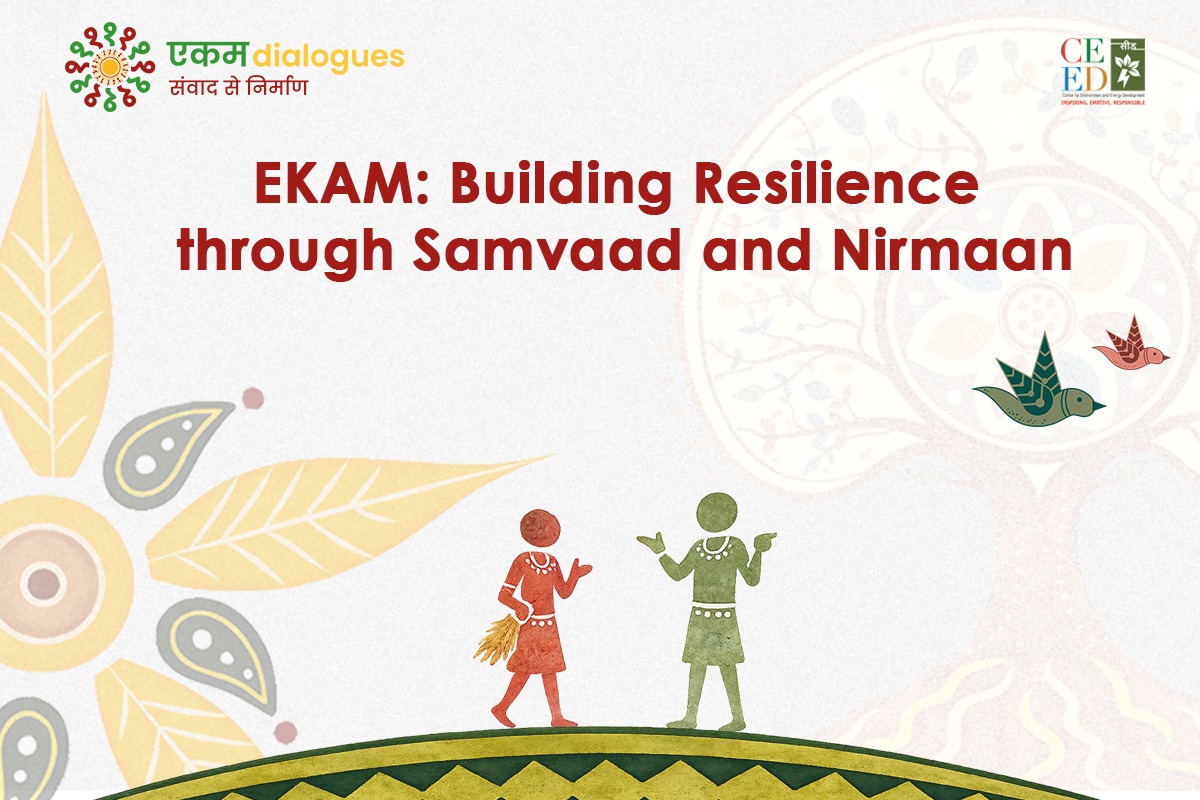
At its core, EKAM is guided by two ideas that are deeply rooted in both tradition and practice – Samvaad and Nirmaan.
Samvaad is often translated as dialogue, but in its truest sense, it is about holding space – for listening without hierarchy, for acknowledging complexity, and for allowing diverse forms of knowledge to coexist. It is where stories, data, policy, and practice intersect, not to compete, but to inform each other.
But Samvaad, on its own, is incomplete.
Nirmaan is what gives it direction. It is about co-creating pathways forward –, strengthening partnerships, informing systems, and translating insights into action that is both scalable and sustainable.
Climate resilience cannot be separated from livelihoods. Livelihoods cannot be separated from culture. Culture cannot be separated from identity and continuity. And none of these can be addressed without responsive systems and sustained investment.
EKAM, therefore, is not a moment of exchange. It is a continuum of understanding and action.
Where Themes Converge, Not Compete
The conversations at EKAM are shaped by themes that are deeply interwoven, reflecting the reality of the region itself.
At one level, they recognise that resilience is inherently people-led, with communities not as passive recipients, but as co-creators of governance, development, and adaptation. This naturally flows into questions of livelihoods and local economies, where dignity of work, the revival of regional industries, and nature-based livelihoods become central to sustainable growth.
But livelihoods here are inseparable from culture, from traditional knowledge systems, food practices, and folklore that have long guided how communities interact with their environment. These are not relics of the past, but living, evolving frameworks of sustainability.
As the region looks forward, the role of technology and youth becomes equally critical, not as an external imposition, but as a tool that is grounded in context, responsive to local needs, and capable of amplifying impact. This, in turn, connects to the need for stronger systems and institutional pathways, where ideas can move beyond pilots to become embedded in planning and governance.
Underlying all of this is the question of capital, not just as funding, but as long-term commitment. How do we ensure that investments align with community priorities, ecological sustainability, and equitable growth?
These are not separate conversations. They are threads of the same fabric, each reinforcing the other, each essential to building resilience that lasts.
EKAM Samman: Honouring the Quiet Architects of Change
If there is one thing that becomes evident while travelling through this region, it is this – the work of building resilience is already underway.
It may not always carry the language of scale or visibility, but it carries something far more powerful – intent, continuity, and deep-rooted impact.
A collective of women in Odisha reviving millet cultivation not just as a crop, but as a movement for nutritional security and economic independence. A group of young practitioners in Jharkhand mapping water bodies and reviving traditional systems of conservation. Tribal communities in Chhattisgarh protect forests while building sustainable, community-owned enterprises around them.
These are not isolated interventions. They are living demonstrations of what resilience looks like on the ground. EKAM Samman is an effort to bring these stories to the centre. But it goes beyond recognition.
It is about reframing leadership – acknowledging that expertise does not reside only in institutions, but within communities. It is about creating visibility for work that often remains localised, and enabling it to inform larger systems of thinking and action. By honouring these changemakers, EKAM seeks to do three things –
to celebrate, to learn, and to amplify. Because when stories of change are shared, they do more than inspire, they create pathways for replication, collaboration, and scale.
In many ways, EKAM Samman is not just about recognising impact. It is about building a collective memory of resilience, one that others can draw from, build upon, and carry forward.
Why CEED, Why Now
For over a decade, the Center for Environment and Energy Development (CEED) has worked across these very landscapes, engaging with state governments on clean energy transitions, economic diversification in climate-vulnerable districts, and supporting communities in navigating the intersections of environment, livelihoods, and development.
In districts where energy access once limited opportunity, CEED has worked to enable decentralised solutions. In regions facing extreme vulnerability, it has contributed to shaping climate-responsive approaches. In policy spaces, it has consistently advocated for subnational action that is both data-driven and people-informed.
Through this work, one insight has become increasingly clear, that while solutions exist, they often remain disconnected from each other. A livelihood solution does not always inform climate planning. A community innovation does not always reach policy tables. A successful model in one district rarely finds its way to another.
EKAM emerges from this realization. It is an effort to bring these strands together, to create a space where knowledge does not remain siloed, where practice informs policy, and where collaboration becomes the norm rather than the exception.
Looking Ahead: From Momentum to Movement
Resilience is often spoken of as an outcome. But in regions like these, it is a process – slow, layered, and deeply human. The question before us is not whether resilience exists. It already does. The question is – can we recognise it, strengthen it, and build with it?
EKAM is an attempt to do just that. Not as a moment, but as a movement. Not as a platform that only speaks, but one that actively listens too. Not as an event that concludes, but as a process that continues. Because the future of this region will not be written in isolation; it will be shaped in conversation, and built in collaboration.
A new Samvaad is taking root. One that seeks Nirmaan – thoughtfully, collectively, and with intent. The invitation now is simple, but significant – to be part of this process, to contribute to this dialogue, and to help shape what comes next.