Ramapati Kumar, CEO, Center for Environment and Energy Development (CEED) |
Earlier this year, record-breaking heat swept across Delhi, floods swept through Jammu and Uttarakhand due to intensified monsoons, and farmers from Maharashtra to Bihar watched their crops wither weeks before harvest. Urban skylines shimmered under smog, while the countryside cracked open in drought. Climate change is no longer a distant warning; it’s the air we breathe, the water we fight for, and the uneven harvests that define rural livelihoods. The sense of urgency is unmistakable.
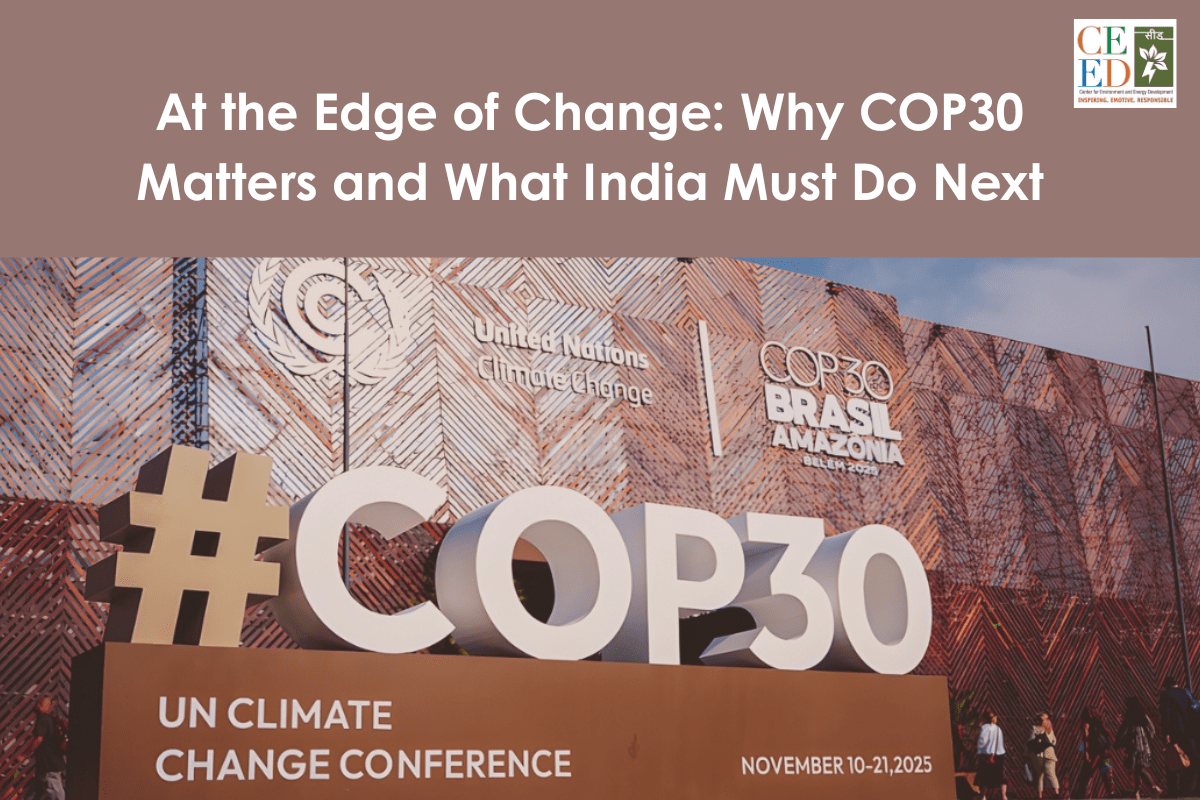
As the world convenes in Belém, Brazil, for COP30, the thirtieth UN Climate Conference, that urgency must translate into resolve. For decades, the climate conversation has revolved around promises; now, it must shift to proof. According to the Climate Policy Initiative (2025), global climate finance has crossed USD 1.9 trillion, yet less than a fifth supports adaptation, the part that helps communities survive the changes already unfolding. Yet adaptation finance, the resources that help communities cope with rapid climate change patterns, remains deeply inadequate. The United Nations Environment Programme’s Adaptation Gap Report 2025 projects that developing countries will need USD hundreds of billions per year just to stay on course.
COP30 is not just another global meeting. It signals a pivotal turning point: the moment when the world moves from pledges to implementation. Its host location, Belém, Brazil was chosen precisely because it lies at the edge of the Amazon rainforest and embodies the convergence of ecological urgency, social inequity and climate risk.
One of COP30’s most promising shifts is the renewed recognition that cities and sub-national governments hold the key to climate resilience. More than 70% of global emissions and 80% of GDP are rooted in urban centres, meaning solutions must be locally led, not only globally debated (WRI, 2025). In this light, expectations from COP30 are clear. First, we must forge multilevel governance systems that link national ambition with city-level execution. Second, we must unlock finance not just for mitigation but for resilience and adaptation, especially in fast-changing regions. Third, the global conversation must support equitable transitions, ensuring communities dependent on extractive industries or vulnerable geographies are not left behind.
For India, the stakes are particularly high. As one of the fastest-growing economies, we stand at the intersection of development ambition and climate responsibility. We are home to 18% of the world’s population but only 4% of its freshwater resources. More than 70% of our workforce depends on climate-sensitive sectors like agriculture, forestry, and fisheries. And as urbanisation accelerates, with over 400 million people expected to live in cities by 2030, our infrastructure, public health, and energy systems face unprecedented strain. India recorded 318 heatwave days in 2024, nearly double the previous decade’s annual average (IMD Data, 2025). Climate change is no longer a distant environmental issue; it is reshaping economies, public health, infrastructure, and livelihoods across the subcontinent.
India has already demonstrated climate leadership, from its Panchamrit commitments at COP26 to becoming the world’s third-largest renewable energy producer. Initiatives like the National Green Hydrogen Mission, PM-KUSUM, and state-level Climate Action Plans show that we are building pathways for low-carbon growth. But the next chapter requires deeper transformation, turning climate ambition into governance, finance, and everyday systems that work for people.
Integrated action, sectoral coherence, and local ownership should be at the heart of conversations and policy implementation. On the ground in Delhi, for example, that means translating a city climate action plan into ward-level heat-resilience programmes; or in Jharkhand, turning a coal-region just-transition strategy into new green jobs. It means every policy must ask: Who is impacted? How will we measure progress? What happens next?
At the Center for Environment and Energy Development (CEED), our work sits at this intersection of policy and place. As COP30 frames the world’s climate future, we remain committed to supporting state governments and city institutions in turning ambition into action, through localised plans, data-driven interventions, and stakeholder convergence. Because global summits may set the direction, but resilience is built in the streets, the factories and the fields.
As COP30 unfolds amidst the Amazon and underlines the importance of land, forest, people and planet, we must not view it as separate from our cities, states or districts. The global summit and a village in Jharkhand are two sides of the same coin. They ask us the same question: How do we build resilience today, together, for all?
In the coming years, meaningful climate action will look less like big speeches at distant summits and more like smart planning in state capitals, inclusive strategy in industrial corridors, and adaptation in villages facing water stress, heat waves and livelihood shocks. The negotiations in Belém must be more than diplomatic theatre, they must become a catalyst for change in neighbourhoods, industries and cities around the world. The moment is now, the pathway is ours to build.