
Accounting and precisely constraining the carbon budget in a region or state is the primary step towards its commitment to carbon-neutrality and achieving the long-term climate goals. Carbon-neutrality is a state of Net- Zero Carbon Dioxide (CO2) emissions. The term “carbon-neutral” also includes other Greenhouse Gases (GHG) in terms of their CO2-equivalence. If the total GHG emitted is equal to the total amount avoided or removed, then the two effects cancel each other out and the net emissions are ‘neutral’. The concept of carbon- neutrality is based on balancing CO2 emissions with its removal associated with various sources including transportation, energy production, agriculture, and industries so that a state of net-zero carbon emission is achieved. The global efforts to achieve carbon-neutrality comprise coalitions of more than 70 countries and several prominent institutions pledging to get to net-zero emissions. India commits to achieve a state of net-zero emissions by the year 2070. Achieving such an ambitious target, therefore, requires collective efforts from all key stakeholders representing diverse sectors.
Jharkhand, a resource-rich state in terms of mining, forests, industries and agriculture, has great potential to lead the nation towards achieving carbon neutrality targets by an inclusive low-carbon economy via transition towards energy sources and industrial processes that produce lesser GHGs. The key sectors that can play major roles in a carbon-neutral Jharkhand are mining, energy generation, medium and small scale industries, agriculture and service sectors, where bringing changes in their processes could lead to offsetting and curbing carbon emissions.
Carbon budgeting and accounting of other emissions of the industry sector (with a much regularized process- control and emission monitoring system) within the state of Jharkhand can kick-off the steps towards understanding the state’s contribution to the nation’s total carbon emissions. In addition to the direct and indirect emissions (under the IPCC Scope 1 and Scope 2 emission accounting), the emissions from the supply chain (under IPCC Scope 3 emission accounting) also need to be reported periodically. Such a primary but crucial step can have both regulatory and technical implications for understanding the state of carbon emissions from key industries. This will also help in the scoping of roadmaps for key carbon-emitting industries of the state.
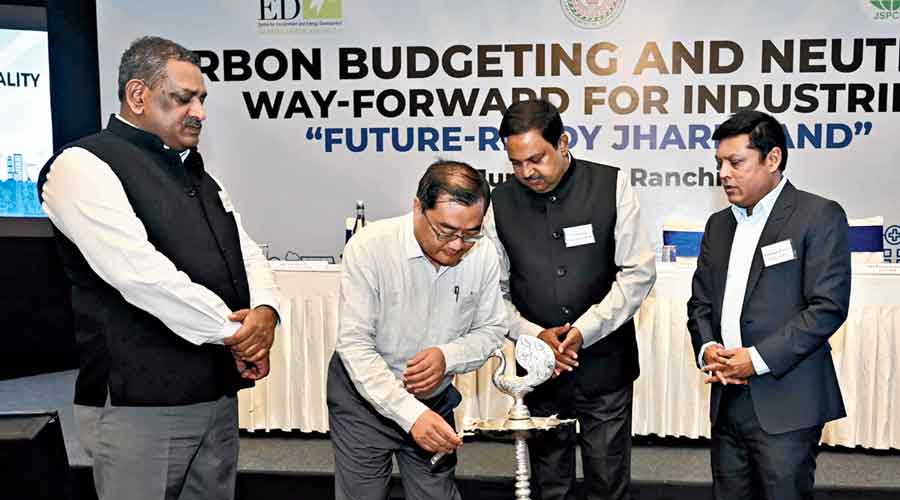
Considering the stronger inter-linkages of economic sectors with each other within and outside the state, the role of the governance structure in coordinating and enabling support to the concerned parties in reducing their carbon footprint is highly inevitable. Therefore, Jharkhand State Pollution Control Board and Department of Forest, Environment and Climate Change, GoJ are the key platforms that can execute coordination with the disparate stakeholders situated in state, industry, academia & civil society and involve them for their commitments toward climate action and sustainability in the state. To understand the broader perspectives on current status of emissions, challenges in their quantification and reporting for carbon budgeting and neutrality, and further develop a suitable roadmap for achieving the net-zero scenario in Jharkhand, a brainstorming between the government agencies, industries and sustainability organizations among other stakeholders from key economic sectors will be the first effective step towards achieving this ambitious climate goal.